
TOYROBOT VIDEO REVIEW #006 - HIGH ROAD TO CHINA (1983) - Released 19th October 2026
Raiders of the Lost Copycat, Tom Selleck’s Flying Circus & A One-Way Ticket to Adventure Lite
Have you ever looked at a movie poster and thought, I'm sure I've seen that film before? You can practically remember the adventure, the leading man, the exotic locations and the ridiculous situations our heroes find themselves in. You settle down, press play, and then gradually realise that you might actually be remembering four completely different films that have somehow merged together in your brain to create a cinematic chimera that never existed.
Is it an age thing? Is it an ’80s thing? Or have I simply watched so many men in leather jackets punching their way across vaguely defined foreign countries that my brain has decided they all belong to the same movie?
Whatever the answer, that was my experience going into High Road to China (1983), ToyRobot Video's sixth release. I genuinely thought I had seen this one before, but it turns out my memory was apparently assembling a bootleg version from several other adventures of the period.
This was, in fact, a first-time watch for me. And after finally getting acquainted with it, I can report that it's… fine. Not terrible. Not particularly remarkable. Just fine.
It's a perfectly serviceable adventure movie with some impressive aerial action, attractive locations, a recognisable leading man and a sweeping John Barry score. But it's also a film that wears its influences on its sleeve so prominently that you occasionally wonder whether somebody has accidentally left the Raiders of the Lost Ark instruction manual open on the production desk.
So, grab your flight goggles, check the fuel in your battered old biplane and prepare for a trip across the globe in search of adventure, romance and something resembling an original idea.
We're taking the high road to China. Whether it's worth the journey is another matter entirely.
Indiana Jones Called. He Wants His Adventure Movie Back.
Released in 1983 and directed by Brian G. Hutton, High Road to China arrives in the wake of a rather significant cinematic event…the release of Raiders of the Lost Ark in 1981.
Steven Spielberg and George Lucas had reminded audiences just how much fun a good old-fashioned adventure movie could be, and Hollywood was understandably keen to find the next big thing. Suddenly, audiences were hungry for globe-trotting heroes, exotic destinations, daring escapes, colourful villains and a leading man who could look good while narrowly avoiding a grisly death.
And if you happened to have a leading man who looked suspiciously like he might have made a decent Indiana Jones himself, all the better….Enter Tom Selleck.
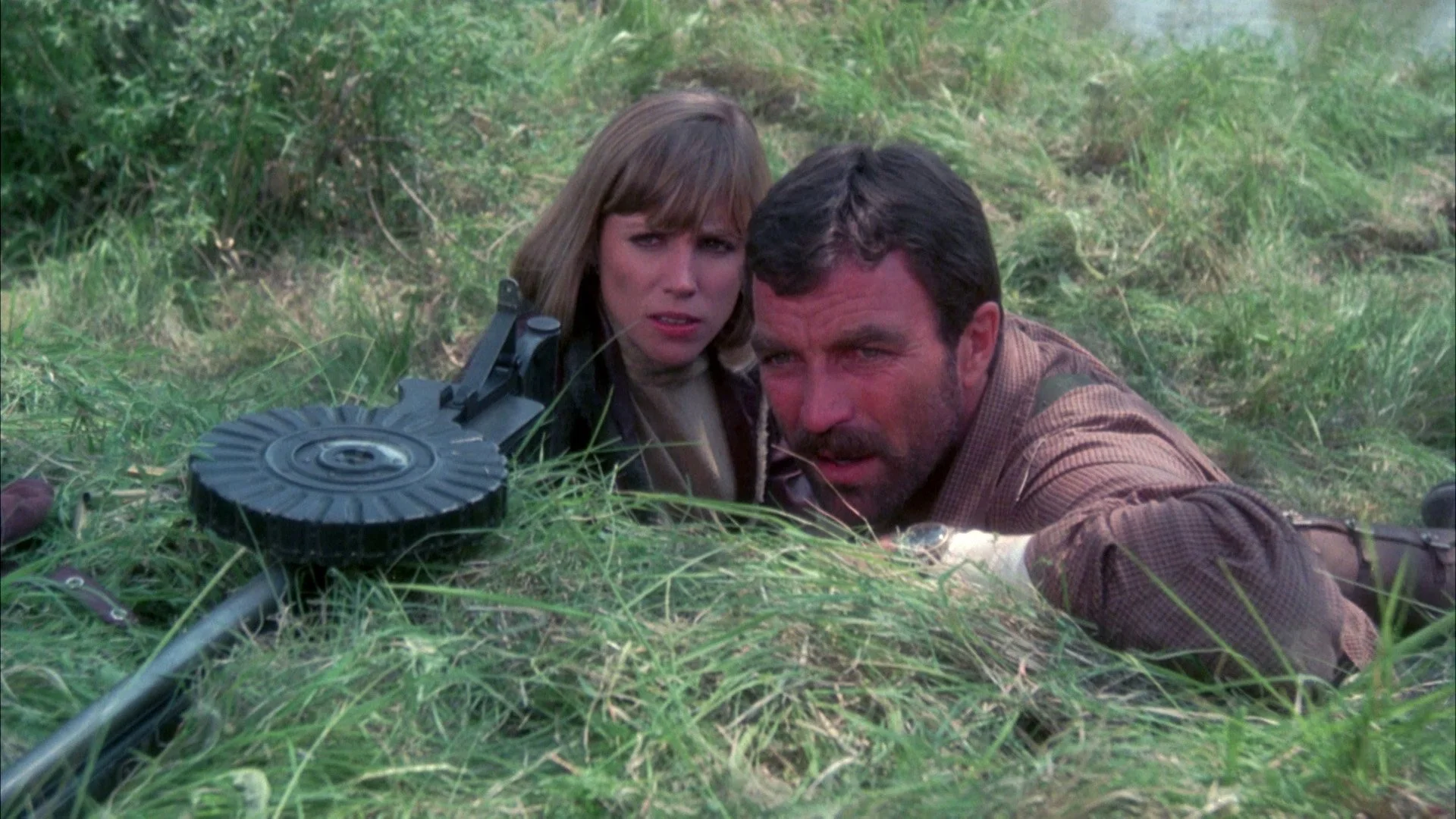
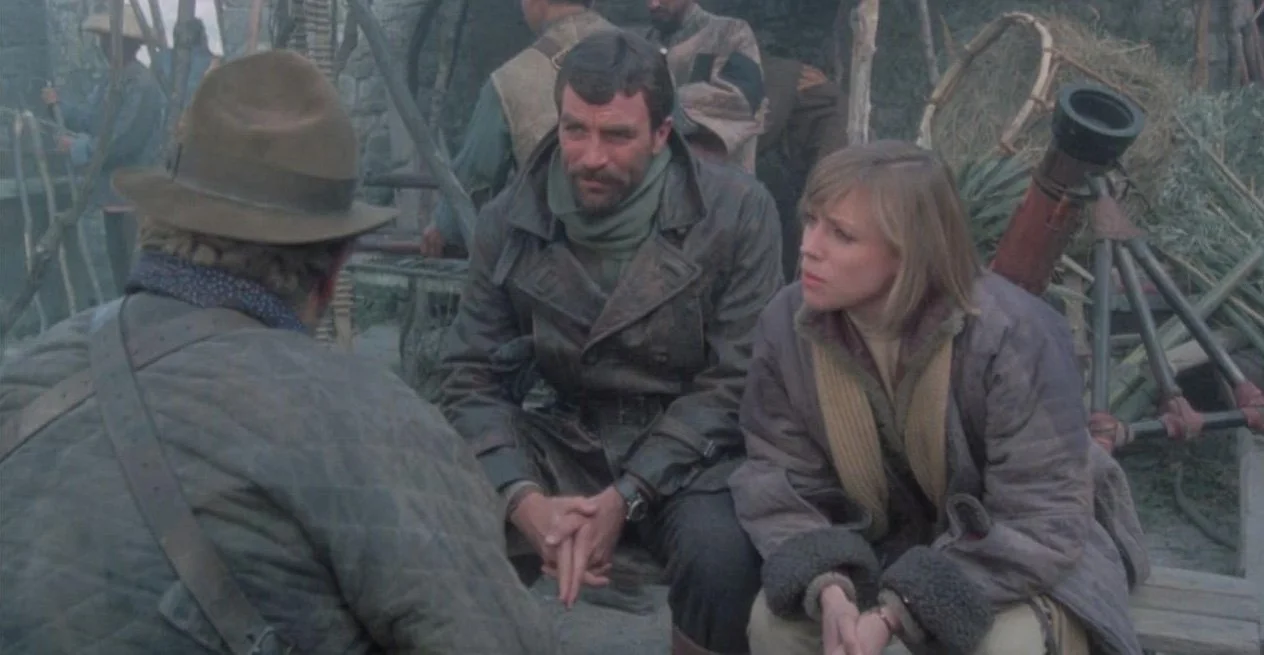
Selleck plays Patrick O'Malley, a washed-up, alcoholic aviator making a living flying around 1920s Turkey. He's a charming rogue with a drink in his hand, a questionable attitude towards responsibility and an aeroplane that looks as though it has spent more time being repaired than actually flying.
His life takes a turn when Eve Tozer (Bess Armstrong), a wealthy American heiress, hires him to find her missing father before he can be declared legally dead and she loses her inheritance.
Naturally, this isn't a simple matter of hopping on a commercial flight and asking somebody at the other end for directions. This is an adventure movie, so the pair must travel across dangerous territory, encounter various unsavoury characters, survive a succession of perilous situations and bicker their way through the entire experience.
Along for the ride is O'Malley's loyal sidekick Struts (Jack Weston), who provides another pair of hands when the flying, fighting and general adventuring become a little too much for our leading man.
What follows is a globe-trotting adventure involving dodgy characters, precarious aircraft, military conflicts and enough narrow escapes to make you wonder how anyone in the 1920s managed to get anywhere without being shot at.
It's all very familiar territory….And that's the problem.
There's nothing inherently wrong with taking inspiration from a successful film. Cinema has been borrowing, adapting and shamelessly nicking ideas from itself since the dawn of the medium. But there's a difference between taking a successful formula and doing something interesting with it, and simply hoping the audience won't notice that you've changed the names and moved the aeroplane.
High Road to China doesn't completely fall into the latter category, but you can certainly see what the filmmakers were aiming for.
It wants the audience to enjoy the same sort of old-fashioned, globe-trotting escapism that made Raiders such a phenomenon. It just doesn't have the same sense of invention, the same crackling wit or the same ability to make every new obstacle feel like an exciting surprise.
Instead, it feels like a film that knows all the ingredients of a great adventure but hasn't quite worked out how to combine them into something truly special.
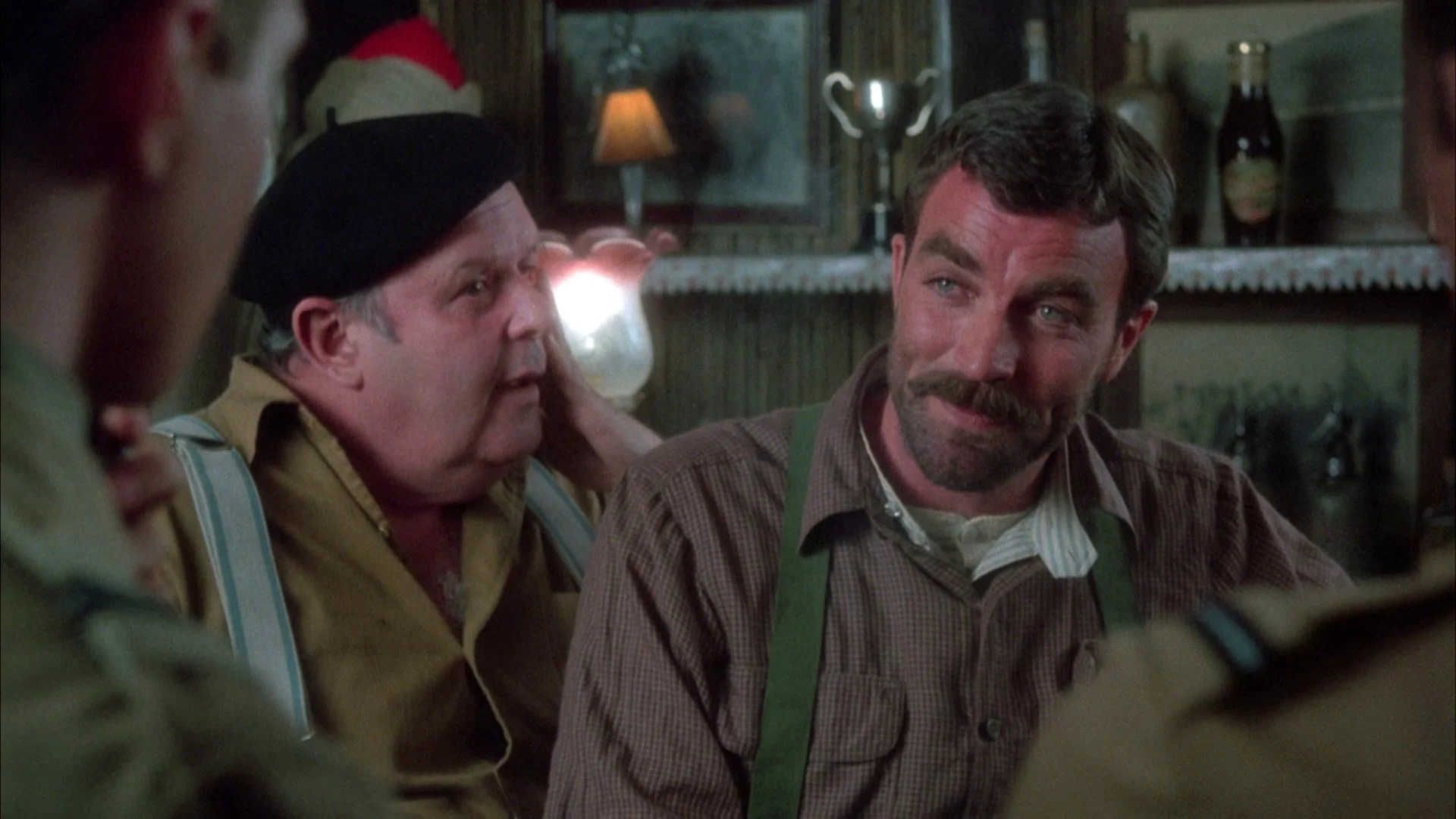
Tom Selleck: The Indiana Jones That Never Was?
Of course, the elephant in the aeroplane is Tom Selleck as by 1983, Selleck was already a familiar face thanks to Magnum, P.I., and his easy-going charisma made him a natural choice to lead a big-screen adventure. He was also famously considered for the role of Indiana Jones before his television commitments prevented him from taking it, leaving Harrison Ford to become one of the most iconic adventure heroes in cinema history.
It's one of those great Hollywood what-ifs. What would an Indiana Jones film starring Selleck have looked like? Would the moustache have survived the expedition? Would the fedora have been quite so magnificent? Would Indy have spent more time looking like he was about to investigate a suspicious noise on a Hawaiian beach?…We'll never know.
What we do have is High Road to China, which gives Selleck the opportunity to headline his own globe-trotting adventure. And, to be fair, he's perfectly likeable in the role.
Selleck has the looks, the charm and the relaxed screen presence needed to play a man who's seen too much trouble to be impressed by any of it. O'Malley is a cynical, slightly dishevelled adventurer who would probably rather be left alone with a bottle of something strong, but who can still be relied upon when the situation gets serious….There's a decent character in there, and Selleck does what he can with him.
The difficulty is that the script doesn't always give him enough to work with. His character's supposed wit and roguish charm don't consistently translate into genuinely funny dialogue, and the film's attempts at verbal sparring can feel more like two people having a rather tedious argument than a battle of quick-witted adventurers.
Selleck himself isn't the problem. He has the screen presence to carry this sort of film, and it's easy to see why somebody thought he could make a compelling cinematic leading man, but charisma can only carry a film so far when the material around it is this familiar.
Watching him here, you can certainly imagine a version of the film that works better. Give him a sharper script, a more interesting series of obstacles and a director willing to inject a little more energy into proceedings, and perhaps we'd have a much more memorable adventure.
As it stands, he's a perfectly good pilot stuck flying a rather average plane.
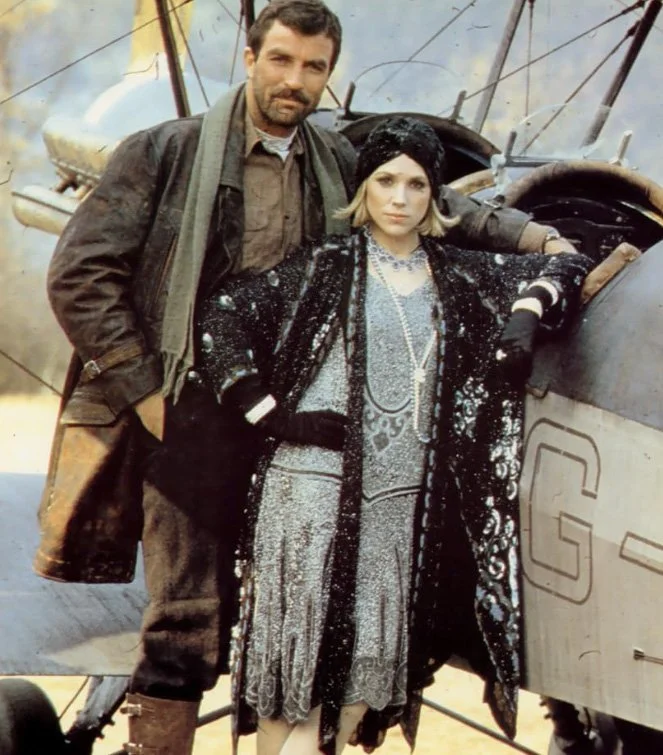
Bess Armstrong and the Romance That Never Quite Takes Off
Opposite Selleck is Bess Armstrong as Eve Tozer, the wealthy heiress whose search for her missing father sets the entire adventure in motion.
Eve is intended to be the strong-willed, high-society foil to O'Malley's cynical, world-weary outlook. She's determined, outspoken and perfectly capable of giving as good as she gets, creating the sort of mismatched partnership that adventure movies and screwball comedies have been exploiting for decades and that idea is sound enough.
Put two people with completely different temperaments together, force them into dangerous situations, let them argue about absolutely everything, and eventually have them realise that their constant bickering is actually a sign of romantic attraction.
What could possibly go wrong?…Well, quite a lot, as it happens.
Armstrong gives Eve plenty of energy, and the character is at least intended to be more than a helpless damsel waiting for a handsome man to rescue her. She's involved in the adventure, contributes to the journey and has a personality of her own, but the relationship between her and O'Malley doesn't always click.
The film clearly wants us to enjoy their combative chemistry, but too many of their exchanges feel predictable. The insults and arguments don't consistently land as comedy, and the gradual transition from mutual irritation to romantic attraction doesn't have quite the emotional spark the filmmakers seem to think it does.
You can practically see the screenplay ticking off the required beats.
Argument? Check.
Dangerous situation? Check.
Moment of vulnerability? Check.
Two people who have spent the last hour irritating each other suddenly discovering that they might actually fancy one another? You'd better believe it.
There's a perfectly respectable adventure-romance buried in here, but the relationship never becomes the compelling centrepiece the film needs it to be.
When your leading couple spends more time making you wish they'd stop arguing than making you believe they're falling in love, something has gone a little awry.
Brian G. Hutton Knows His Way Around an Adventure… Mostly
One of the more interesting aspects of High Road to China is its director, Brian G. Hutton.
Hutton had previously directed films including Where Eagles Dare (1968) and Kelly's Heroes (1970), so he wasn't exactly a newcomer when it came to large-scale action and adventure with those earlier films demonstrated an ability to handle complicated action sequences, military settings and ensemble casts, making him a sensible choice for a production that needed to deliver plenty of spectacle.
And there are moments when that experience shows.
The aerial sequences are among the film's strongest assets. Watching the biplanes weave through the landscape, engage in dangerous manoeuvres and get themselves into increasingly precarious situations provides a welcome dose of excitement. These scenes give the film a physical dimension that helps distinguish it from a straightforward adventure-comedy built entirely around dialogue.
There's a sense of scale to the production, too. Filmed largely in Yugoslavia, with additional work in England, the film benefits from attractive scenery and locations that help sell the characters' journey across unfamiliar territory.
The production doesn't always feel as convincing as it might, but it at least gives us something interesting to look at.
Unfortunately, the direction elsewhere is rather less inspired.
The film moves through its various set pieces without quite building the momentum needed to make them feel like parts of a thrilling adventure. There's action, there's danger and there's a succession of increasingly difficult situations, but the connective tissue between them isn't especially compelling.
It sometimes feels as though the filmmakers are relying on the basic promise of the genre to carry the audience through the quieter stretches. And that can work, provided the film has enough energy, humour and personality to keep things moving, however here, the results are mixed.
Hutton clearly knows how to stage action, but High Road to China lacks the sharpness and confidence needed to turn its individual ingredients into a truly memorable whole. It's competent filmmaking, but rarely inspired filmmaking.
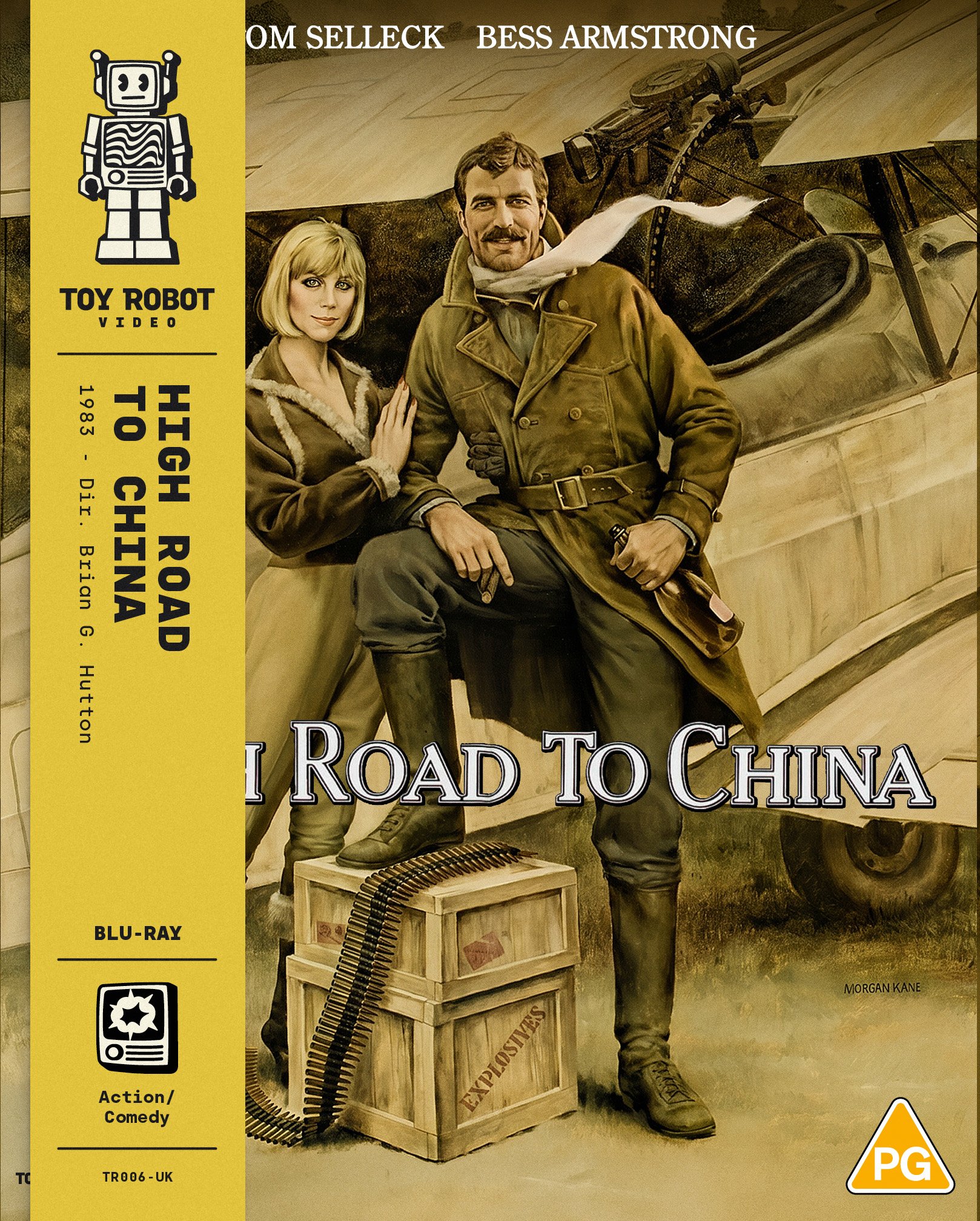
Aerial Stunts, Exotic Locations and a John Barry Score
If there's one area where High Road to China deserves genuine credit, it's the production's visual and musical presentation.
The aerial action provides some of the film's most entertaining moments, while the Yugoslav locations give the adventure a sense of geographical variety. The scenery helps create the impression that our heroes are travelling through a much larger world than the relatively straightforward plot might suggest.
And then there's John Barry.
The legendary composer provides a sweeping score that brings a welcome sense of grandeur to the proceedings. Barry had a remarkable ability to make cinematic adventures feel important, whether he was scoring espionage thrillers, sweeping romances or grand historical dramas.
His work here gives the film a sense of scale and romance that the screenplay doesn't always manage to generate on its own.
The music lifts the quieter moments, supports the action and helps sell the old-fashioned adventure atmosphere the production is aiming for.
It also provides a useful reminder that this is a film made by people who understood the appeal of classic cinematic escapism. There's an attempt to create something with a sense of grandeur, something that feels like a proper big-screen adventure rather than a disposable piece of television entertainment.
Whether the finished film quite achieves that ambition is another question, but Barry's score certainly helps.
It's one of the film's most effective elements, and it gives the adventure a little extra personality when the writing and direction aren't doing quite enough.
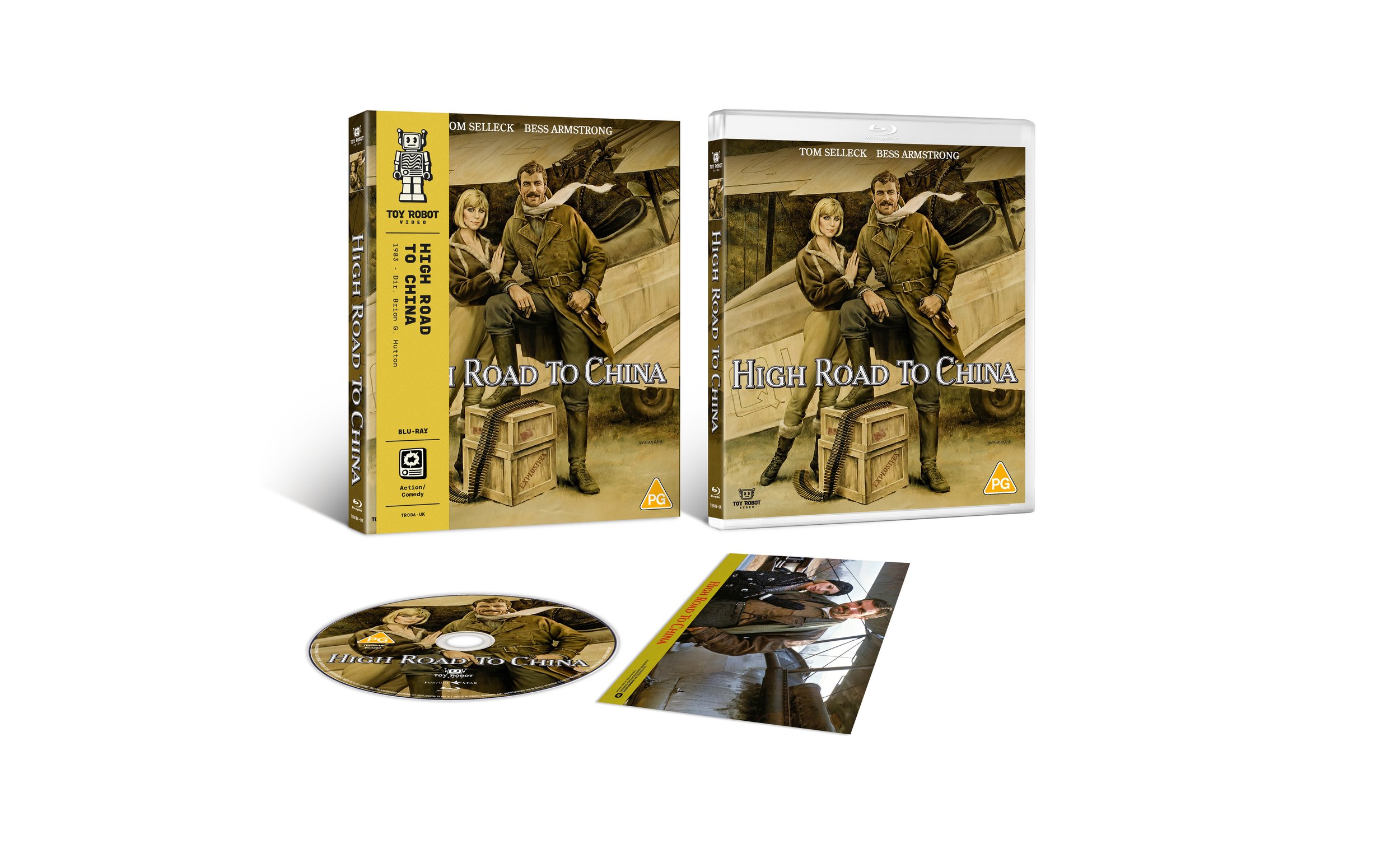
The Problem With Being Almost Indiana Jones
Ultimately, High Road to China suffers from a problem that affected plenty of films in the wake of Raiders of the Lost Ark….When a movie becomes a massive hit, everyone wants a piece of the action. Studios start looking for the next version of that success, filmmakers borrow the elements that worked, and audiences are suddenly offered a succession of films promising the same sort of excitement.
Sometimes those films manage to find their own identity. Sometimes they become beloved cult classics in their own right. And sometimes they end up feeling like perfectly acceptable imitations of something much better.
High Road to China falls somewhere in the middle.
It's not a disaster, and I don't think it deserves to be dismissed simply because it arrived in the wake of Spielberg and Lucas's adventure classic. There are enjoyable elements here, particularly Selleck's performance, the aerial sequences, the locations and Barry's score, but the film never quite escapes the shadow of its more successful inspiration.
The humour isn't consistently sharp enough, the romantic relationship doesn't have the chemistry required to carry the story, and the adventure itself rarely feels as exciting or unpredictable as it should.
The result is a film that seems content to cruise along at a comfortable altitude rather than attempting anything particularly daring.
Which is a shame, because there's enough here to suggest that a better film was possible.
A stronger script, more energetic direction and a little more imagination could have turned High Road to China into a much more satisfying adventure. Instead, it remains an amiable but rather unremarkable entry in the post-Raiders boom.
You watch it, enjoy a few moments, appreciate the craftsmanship on display and then move on with your life. And honestly, there's nothing wrong with that.
Not every film needs to change your life. Sometimes you just want to watch Tom Selleck fly an old aeroplane across a scenic landscape while John Barry does his thing in the background.
It's just that, when you're competing with Raiders of the Lost Ark, being merely fine isn't quite enough.
ToyRobot Video EXTRA’S
With High Road to China, ToyRobot Video continues its early run of releases with a film that sits comfortably within the broad world of cult and genre cinema, even if it's not quite the hidden masterpiece some might hope to discover.
It's also a useful reminder that the label's appeal isn't limited to horror, exploitation or the most outrageous corners of the cinematic back catalogue. There's room for old-fashioned adventure movies, films that once had a place in the multiplex but have gradually slipped out of the wider conversation.
This one certainly has a story worth revisiting, particularly given Tom Selleck's near-miss with Raiders of the Lost Ark and the film's place in the wave of adventure productions that followed.
As with the previous ToyRobot releases I've covered, I haven't received the productised physical edition, so I can't comment on the packaging or any physical extras that might accompany the disc. I'm therefore judging the release based on the film and the special features listed in the official press information.
The Blu-ray edition includes:
New interview with actress Bess Armstrong: Free As A Bird.
New interview with associate producer Frederick Muller: Taking the High Road.
New feature: Vic Pratt on High Road to China.
Original theatrical trailer.
It's not the most extensive collection of extras you'll ever encounter, but the interviews and retrospective feature offer a welcome opportunity to explore the production and the film's place in the adventure-movie landscape.
Given the film's history, I'd be particularly interested in hearing more about how the production came together, the challenges of filming the aerial sequences and the decision to bring Selleck into the leading role.
For now, though, the lack of a physical package means I'm unable to assess the complete edition. The score reflects my reaction to the film and the listed extras, with the final verdict on the physical release reserved until I can get my hands on it.
THE TOYROBOT SCORE
High Road to China – The Movie: ★★ / 5
Special Features: ★★½ / 5
Overall Release Score: ★★½ / 5
High Road to China is a perfectly watchable adventure movie that offers a little bit of everything you'd expect from an early-'80s production: a charismatic leading man, exotic locations, daring aerial stunts, romantic bickering and a sweeping musical score.
Tom Selleck is likeable, Bess Armstrong brings energy to her role, and the film looks good enough to keep you interested even when the story begins to feel rather familiar. John Barry's music is another highlight, giving the adventure a sense of grandeur that helps compensate for some of the weaker elements, but the film never quite finds its own identity.
The Raiders of the Lost Ark comparisons are inevitable, and while High Road to China has enough going for it to remain entertaining, it lacks the wit, pace and imagination required to stand alongside Spielberg's classic.
The romance is predictable, the dialogue doesn't always land, and the whole experience feels more like a collection of familiar adventure-movie ingredients than something particularly distinctive.
I'm glad I finally watched it, and I can certainly understand why it might appeal to fans of old-fashioned adventure cinema. But I can't pretend it's a film that's going to live long in the memory.
Then again, perhaps I've already seen it in my head. Maybe I've simply mistaken it for Romancing the Stone, The Jewel of the Nile, The Man from Snowy River and three other films I've half-remembered from the same era….If so, I apologise to all six movies for the confusion.
So, if you're in the mood for a bit of vintage adventure, fancy seeing Tom Selleck in a role that gives us a glimpse of what might have been, or simply want to spend an afternoon watching biplanes get into trouble while John Barry supplies the musical grandeur, High Road to China will do the job.
Just don't expect it to reach the heights of Raiders of the Lost Ark.
After all, not every road leads to cinematic gold. Some just take you on a pleasant scenic route before dropping you back where you started.
Release Information
Title: High Road to China (1983)
Distributor: ToyRobot Video
Release date: 19 October 2026
Catalogue code: TR006-UK
Barcode: 5027035030845
Format: Blu-ray
Discs: 1
Country: Hong Kong, Yugoslavia, USA
Genre: Adventure / Drama
Director: Brian G. Hutton
Cast: Tom Selleck, Bess Armstrong, Jack Weston, Wilford Brimley, Brian Blessed, Robert Morley, Lynda La Plante
BBFC rating: PG
Aspect ratio: 1.85:1
Audio: DTS-HD 2.0 Mono
Language: English
Subtitles: English SDH
Runtime: 105 minutes
RRP: £21.99
Special Features:
NEW: Free As A Bird — interview with actress Bess Armstrong.
NEW: Taking the High Road — interview with associate producer Frederick Muller.
NEW: Vic Pratt on High Road to China.
Original theatrical trailer.
Release information source: ToyRobot Video / Fetch Publicity.