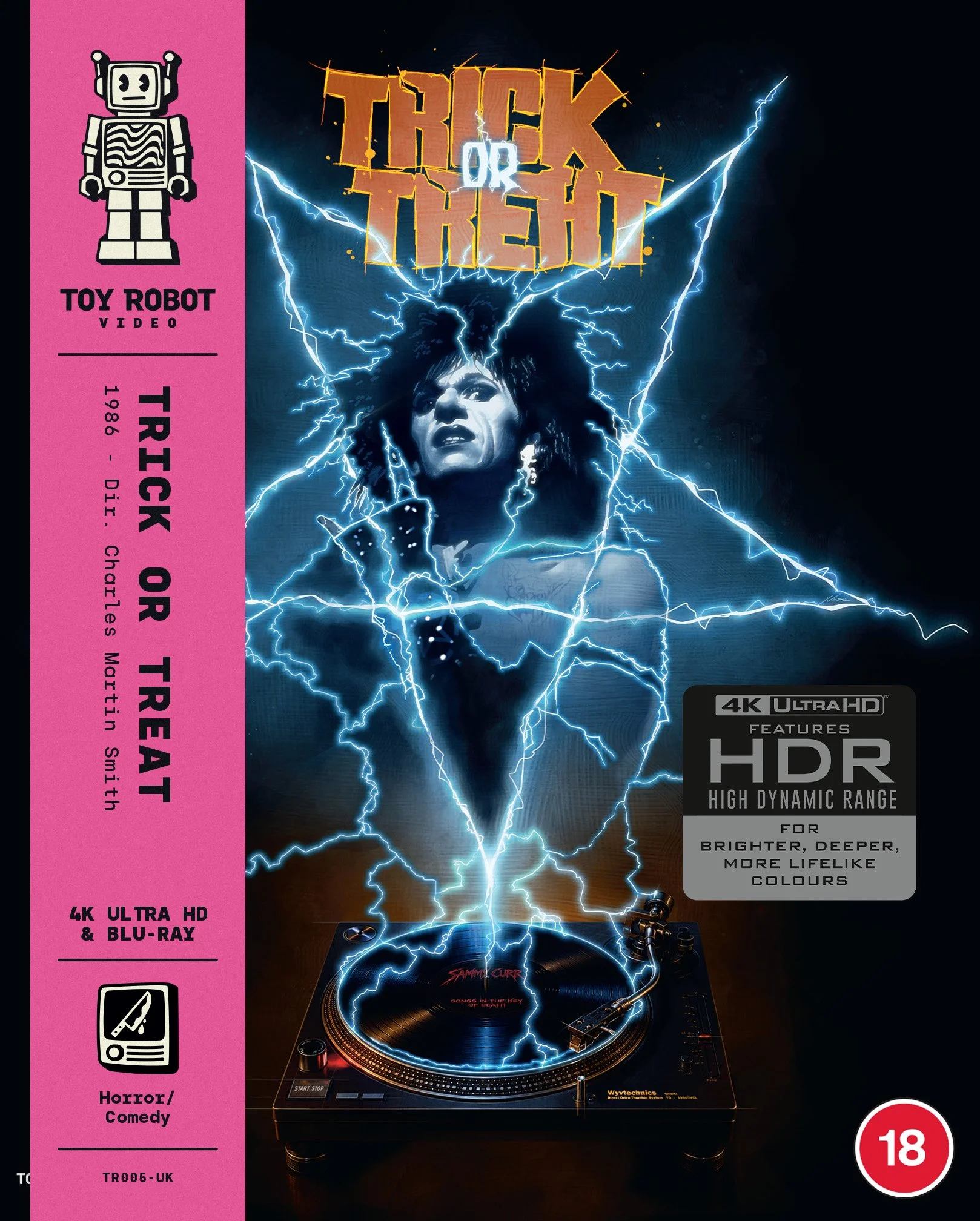
TOYROBOT VIDEO REVIEW #005 - TRICK OR TREAT (1986) - Released 5th October 2026
Satanic Panic, Heavy Metal Anthems, Rock-Star Cameos & One Hell of a Halloween Encore
There are few things more gloriously ’80s than big hair, bigger guitar solos, horror films that promise Satanic shenanigans, and concerned adults who appear to believe that playing a heavy metal record backwards will summon the Devil straight into your living room. And if you were knocking about in the video rental shops of the decade, there’s a good chance that Trick or Treat was lurking somewhere on the shelves, waiting to corrupt the youth and give their parents another reason to confiscate their Iron Maiden or Metallica T-shirts.
For me, this is a film that feels right at home. I’ve watched it plenty of times over the years, partly because it’s a familiar face from the golden age of ’80s VHS rentals, and partly because heavy metal has always been my musical genre of choice. Put the two together and you’ve got the cinematic equivalent of finding a battered old denim jacket in the wardrobe, discovering that it still fits, and immediately cranking the stereo up loud enough to annoy the neighbours.
So, with October rolling around and Halloween just around the corner, ToyRobot Video’s fifth release is about as seasonally appropriate as you could ask for. We’re talking Trick or Treat (1986), a heavy metal horror-comedy that brings together supernatural shenanigans, teenage rebellion, a soundtrack by Fastway, and appearances from two genuine rock legends. What’s not to love?
Well, as it turns out, there are a few things. But let’s not get ahead of ourselves.
Rock ’n’ Roll Will Never Die… Apparently, Neither Will Its Most Annoying Fans
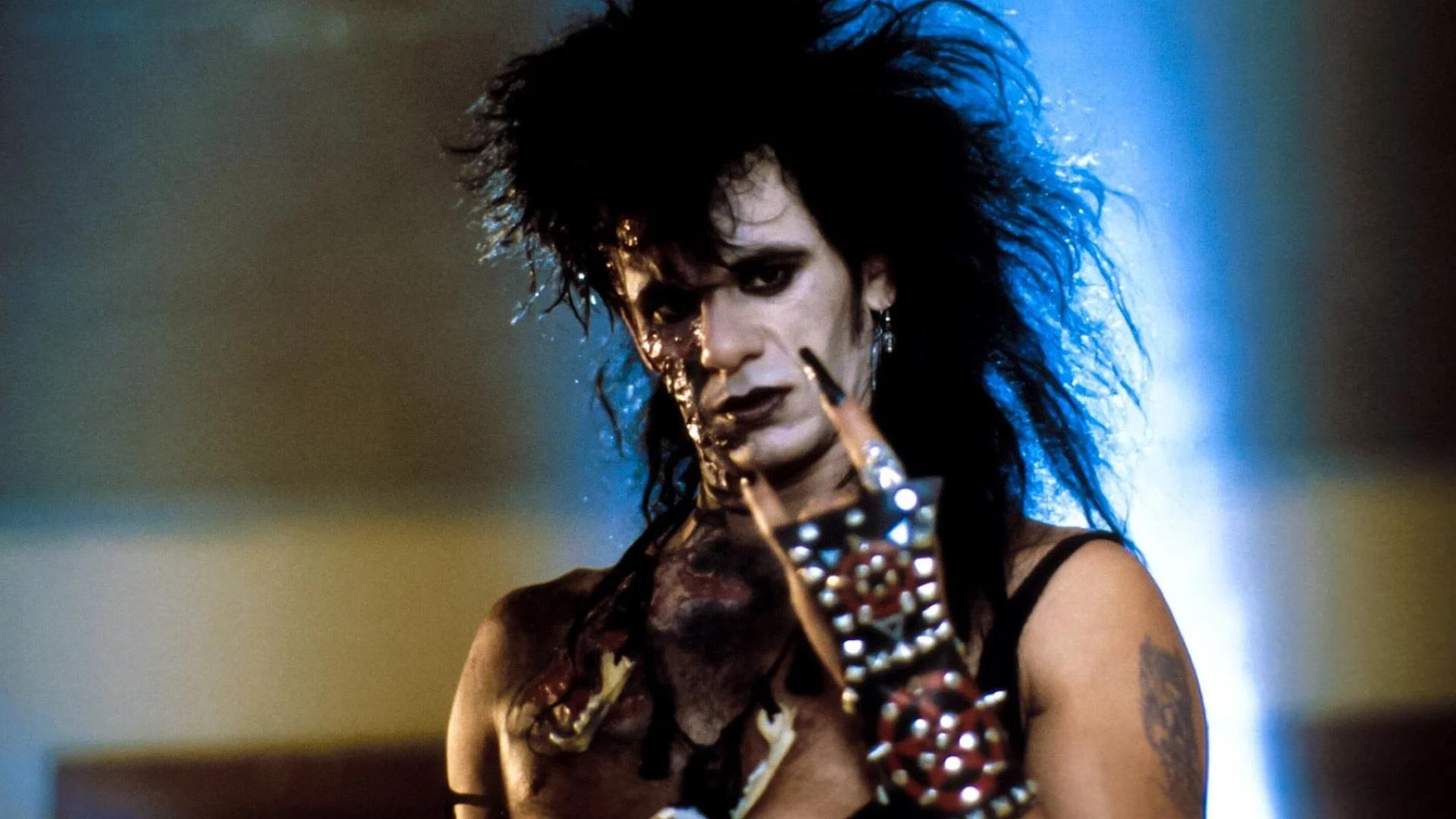
Directed by Charles Martin Smith, Trick or Treat follows Eddie Weinbauer (Marc Price), a bullied teenager whose devotion to heavy metal makes him a target for the local school’s charming collection of arseholes. Eddie’s one real escape is his musical idol, Sammi Curr (Tony Fields), a controversial metal frontman whose outrageous reputation has made him a hero to fans and public enemy number one to anyone who thinks a guitar solo is a gateway to eternal damnation.
When Sammi dies in a hotel fire, Eddie is understandably devastated. But after getting hold of an unreleased recording of his hero’s music, he discovers that there may be more to Sammi Curr than leather trousers, stage theatrics and an impressive ability to upset the neighbours.
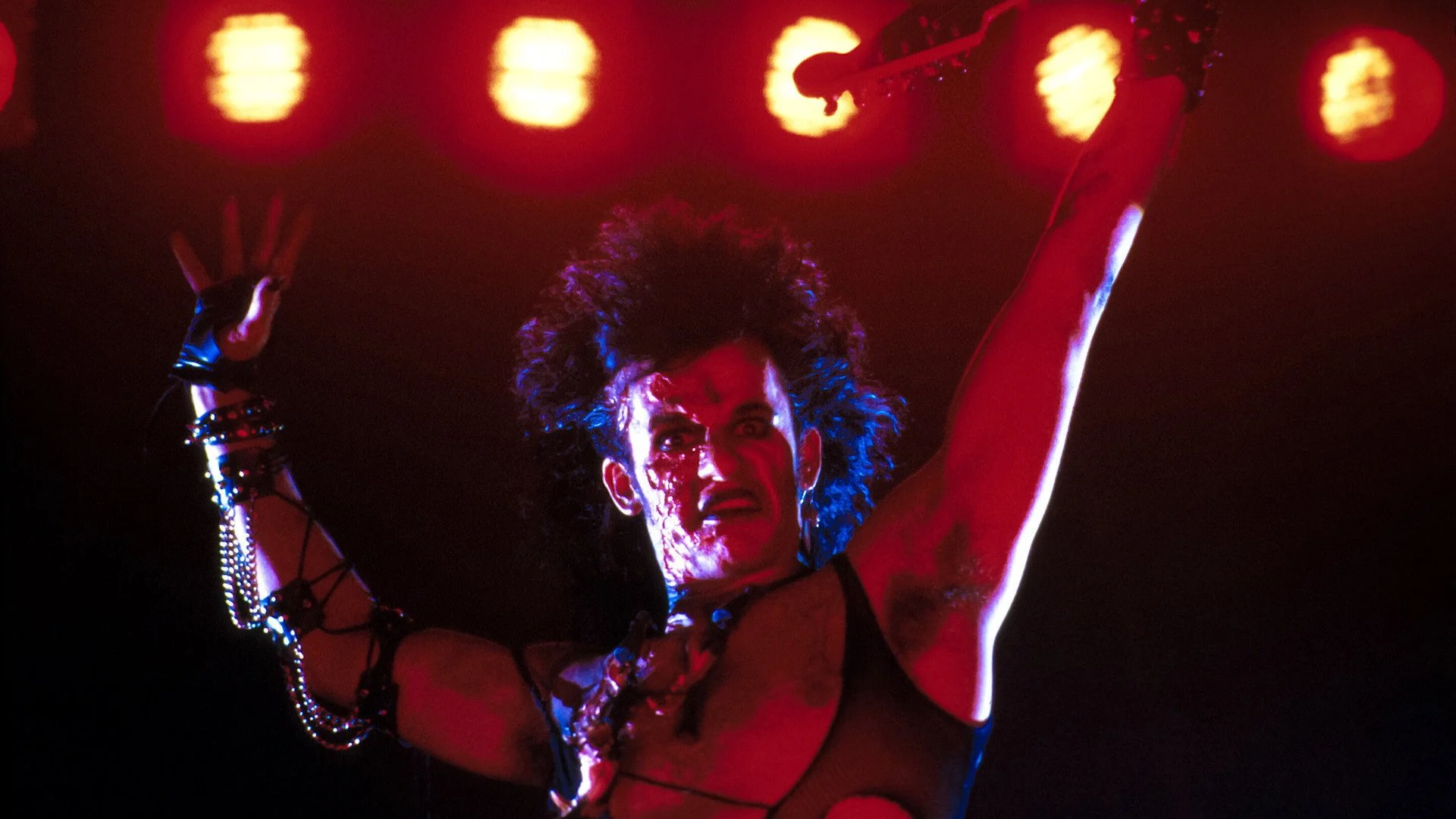
It turns out that death hasn’t done much to dampen Sammi’s enthusiasm for rock ’n’ roll. In fact, he’s discovered a new way to reach his audience, and it involves a little supernatural interference, a lot of electrical mayhem, and the sort of behaviour that would have a health-and-safety officer spontaneously combusting.
Before long, Eddie’s musical obsession becomes something much more sinister, and the film starts playing around with the idea that the music the adults fear might genuinely have some dark power behind it.
It’s a daft premise, naturally, but one that works because the film understands exactly what kind of playground it’s operating in. This isn’t trying to be some miserable, self-important meditation on the evils of popular music. It’s a horror film that wants to plug in, turn up and have a bloody good time.
Although, given the film’s relatively restrained approach to the bloodletting, perhaps bloody is doing a little too much heavy lifting there.
Satanic Panic: When Parents Just Don’t Understand
One of the most interesting things about revisiting Trick or Treat is how neatly it captures the atmosphere of the 1980s Satanic Panic, a subject that has become weirdly prescient (of sorts) in the current political climate
For anyone unfamiliar with this particular chapter in the history of people getting themselves worked up over things they don’t understand, the era was packed with anxiety about occult influences, alleged Satanic cults, and the supposedly corrupting effect of popular culture on impressionable young minds. Heavy metal became a particularly convenient target, with its imagery, provocative lyrics, long hair and general refusal to dress like a respectable accountant.
Then there was backmasking: the idea that hidden messages could be embedded in recordings and revealed by playing them backwards. To certain concerned listeners, your record collection wasn’t simply a collection of music. It was apparently a portal to the underworld, and your favourite band was quite possibly trying to recruit you into Lucifer’s fan club.
You can practically hear the collective sigh of every metalhead who just wanted to listen to a bloody album in peace.
Trick or Treat takes that cultural paranoia and has a good old rummage around inside it. The film understands the absurdity of adults panicking about music they neither enjoy nor understand, while simultaneously having a bit of fun with the possibility that the supernatural nonsense they’re worrying about might actually be real.
It’s a clever little balancing act. The film isn’t simply laughing at the parents, the preachers or the people convinced that a guitar riff is going to destroy civilisation. It uses their hysteria as the foundation for its horror story, allowing the ridiculousness of the real-world panic to bleed into the fictional supernatural threat.
That gives the movie an added layer of charm today. The fashions, the attitudes and the cultural anxieties are all wonderfully specific to their time, making Trick or Treat a little cinematic time capsule of a period when the right combination of long hair, loud music and a suspicious-looking album cover could apparently bring society to its knees.
And honestly, if you’re going to make a horror film about heavy metal, you might as well make one that understands why some people were so frightened of it in the first place.
Fastway to Hell: The Soundtrack Is an Absolute Ripper
Let’s get one thing straight, the soundtrack is a massive part of what makes Trick or Treat work.
The music comes courtesy of Fastway, the British rock band formed by former Motörhead guitarist “Fast” Eddie Clarke and UFO bassist Pete Way, with Dave King on vocals. Their contribution gives the film a proper heavy metal heartbeat, rather than making the music feel like something a studio executive has hastily assembled after being told that teenagers apparently enjoy guitars.
The songs fit the film’s aesthetic beautifully. They’re loud, theatrical, catchy and unapologetically rooted in the period. They sound like the sort of music you’d blast through a cheap pair of speakers while trying to convince your parents that your future career as a professional metalhead was perfectly reasonable.
For a film built around the relationship between music and identity, that authenticity matters. Eddie’s devotion to Sammi Curr feels believable because the movie gives us music that actually feels worth being devoted to. Sammi isn’t simply a fictional musician whose records exist to move the plot along; the soundtrack helps sell him as a genuine idol with a following.
And when the film leans into the connection between the music and the supernatural, it has the good sense to let the soundtrack do a lot of the work. The songs give the whole thing a sense of occasion, turning what might otherwise be a fairly ordinary teenage horror story into something with a distinct musical personality.
As someone who has spent plenty of time with heavy metal, this is one of the film’s strongest selling points. The soundtrack isn’t merely a pleasant bonus or a nostalgic curiosity. It’s part of the film’s DNA.
You could argue that the music is doing some of the heavy lifting when the plot starts dragging its feet, but when the alternative is another ten minutes of teenagers looking miserable in a corridor, I’m quite happy to let Fastway take the wheel.
Turn it up.
Gene Simmons, Ozzy Osbourne & The Cameos from Rock ’n’ Roll Royalty
Then there are the cameos.
First up, we have Gene Simmons of KISS fame, appearing as Nuke, a local radio DJ who becomes involved in Eddie’s increasingly bizarre predicament. Simmons is an inspired bit of casting, bringing genuine rock-star credibility to a film that already has heavy metal running through its veins.
It’s a short appearance, but that’s part of the charm. You don’t need Simmons to deliver a feature-length dissertation on the cultural significance of arena rock. His presence is enough to give the film an extra shot of authenticity, and there’s something wonderfully appropriate about seeing a member of one of rock’s most theatrical bands turn up in a movie about the supernatural dangers of music.
And then there’s Ozzy Osbourne.
In one of the film’s best little jokes, the Prince of Darkness appears as a television evangelist railing against the evils of rock music. Yes, Ozzy Osbourne, a man whose public image had spent years making conservative parents reach for the smelling salts, is cast as the fellow telling everyone that heavy metal is dangerous.
It’s a lovely bit of tongue-in-cheek casting, and one that makes the film’s satire even more effective. The real-life rock star becomes the voice of the people who would presumably like to see his own music banned, creating a wonderfully ridiculous contrast between the performer and the character he’s playing.
It’s the sort of cameo that works because it doesn’t feel like a desperate attempt to make the film seem cooler than it is. Simmons and Osbourne belong in this world, and their appearances add to the film’s identity rather than distracting from it.
They’re also a reminder of just how closely horror and heavy metal were intertwined in the popular imagination of the decade. Both were regularly treated as dangerous influences, both attracted devoted fans, and both were perfectly happy to cultivate an image that made conservative America uncomfortable.
So, naturally, Trick or Treat brings them together and has a bit of fun at everyone’s expense.
A Slow Burn Before the Amp Blows
For all the things I enjoy about Trick or Treat, it isn’t without its problems. And because this is a film I’ve watched plenty of times, I’m not going to pretend that familiarity has somehow made those issues disappear.
The biggest is pacing.
The film takes a while to get moving, spending a fair amount of time establishing Eddie’s unhappy existence, his obsession with Sammi Curr and the general collection of people making his teenage years miserable. There’s nothing inherently wrong with that groundwork, and it does give us a better understanding of why Eddie is so susceptible to the strange events that follow.
The trouble is that the film doesn’t always make the journey as entertaining as it could be.
There are stretches where the narrative feels like it’s idling in the car park, waiting for somebody to turn the key. You know the supernatural fireworks are coming, and the film has already made it clear that Sammi Curr is not going to stay politely buried, but it takes its time getting to the good stuff.
Once the darker elements begin to take hold and Sammi’s influence becomes more pronounced, the film finds a better rhythm. The premise starts paying dividends, the horror and comedy begin to mesh more effectively, and the story gets to indulge in the sort of supernatural rock ’n’ roll nonsense that brought us here in the first place.
But the wait can be a little frustrating, particularly when you’re watching the film for its horror credentials as much as its heavy metal atmosphere.
This isn’t a deal-breaker, and I’d much rather a film take a little time to establish its characters than sprint straight into a collection of disconnected set pieces. Nevertheless, there’s a more energetic, more entertaining version of Trick or Treat buried somewhere in here — one that gets the guitars screaming and the supernatural shenanigans underway a little sooner.
Where’s the Gore? This Is Supposed to Be Horror, Not a Power Ballad
The other slight disappointment is the film’s relatively restrained approach to gore.
Given the subject matter, you might reasonably expect Trick or Treat to be a little more vicious. We’re dealing with a murderous rock star, supernatural powers, electrical deaths and a film that has no shortage of opportunities to turn its horror up to eleven. Yet the kills tend to be more about electrical effects, lightning and supernatural spectacle than the sort of messy, practical gore that would make a dedicated horror fan sit up and pay attention.
There’s nothing wrong with that approach in itself. The electrical effects fit the movie’s aesthetic, and the supernatural side of the story gives the filmmakers plenty of opportunities to get creative without necessarily resorting to buckets of fake blood.
But I can’t help feeling that the film plays things a little too safely.
For a movie about a heavy metal star returning from the dead to wreak havoc, there’s room for a bit more bite. The film has the attitude, the music and the imagery, but the violence rarely feels as extreme as the premise suggests it could be. If you’re coming to this expecting a full-on splatterfest, you may find yourself wondering whether somebody has accidentally put the wrong tape in the VCR.
Could this have been influenced by the expectations of the American ratings system? It’s possible, but I wouldn’t claim that the MPAA forced the film to tone down its gore without evidence to support it. The PG-13 rating had already been introduced in 1984, and by 1990 the MPAA was adding content descriptors to explain the elements behind ratings. Neither fact, however, proves that ratings pressure dictated the specific creative choices made on Trick or Treat.
My suspicion is that the film is simply more interested in its music, its satire and its supernatural gimmickry than in pushing the boundaries of graphic horror. That’s fair enough, but it does leave the more bloodthirsty among us wanting a little more carnage with our chorus.
I’m not asking for every kill to resemble a particularly unpleasant album cover. Just give me a little more meat on the bones.
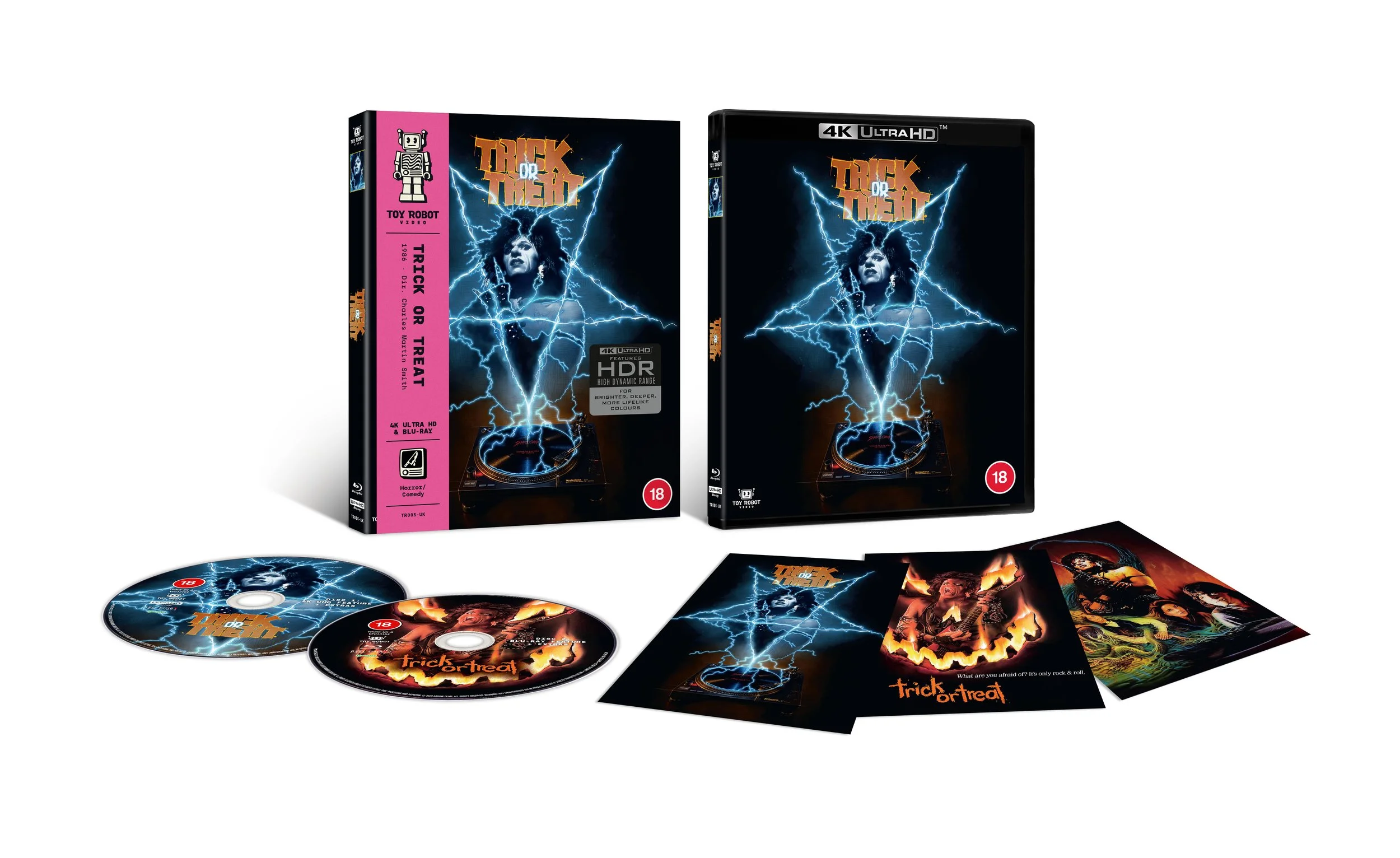
ToyRobot Video EXTRA’S
With Trick or Treat, ToyRobot Video continues its debut run with a title that feels particularly well suited to an October release. It’s an ’80s cult favourite that brings together horror, comedy, heavy metal and a very specific strain of cultural paranoia, all wrapped up in a film that wears its era proudly.
It also demonstrates the appeal of a label willing to explore different corners of cult cinema. This isn’t simply another forgotten horror film dragged out of the vault for the sake of nostalgia. It’s a title with a distinct personality, a soundtrack worth revisiting and a cultural context that gives it more to chew on than its supernatural premise might initially suggest.
For this release, the supplied specifications list a Dual Format edition containing both 4K UHD and Blu-ray discs, with a 4K restoration and a new 5.1 surround sound mix. The special features also look particularly promising on paper, offering a mixture of production history, interviews, location exploration and material devoted to the film’s place within the wider world of Satanic Panic and pop-cultural paranoia.
I haven’t received the productised physical edition, however, so I can’t comment on the packaging, booklet or any other physical extras that may form part of the complete retail package. That’s particularly relevant here, because the accompanying material could make a difference to the overall value of the release.
The listed extras include:
Audio commentary with director Charles Martin Smith, moderated by filmmaker Mark Savage.
Audio interviews with writer/producer Michael S. Murphey and writer Rhet Topham, moderated by Michael Felsher.
An audio conversation with Paul Corupe and Allison Lang, authors of Satanic Panic: Pop-Cultural Paranoia in the 1980s.
Rock & Shock: The Making of Trick or Treat.
In The Spotlight: A Tribute to Tony Fields.
Horror’s Hallowed Grounds: The Filming Locations of Trick or Treat.
The “After Midnight” music video.
A stills gallery featuring an optional audio interview with photographer Phillip V. Caruso.
Theatrical trailers, TV spots, radio spots and a press kit.
Its a healthy amount and having worked my way trhough them its what I’ve started to expect from this boutique label. Especially the material examining the film’s production and its place in the cultural landscape of the decade. The conversation with the authors of Satanic Panic: Pop-Cultural Paranoia in the 1980s is particularly appealing given how much of the film’s identity revolves around those anxieties.
I’d like to get hands-on with the complete release before deciding whether the package deserves a little extra credit. For now, the film itself gets the score, with the final verdict on the overall edition left open until I can properly assess everything included.
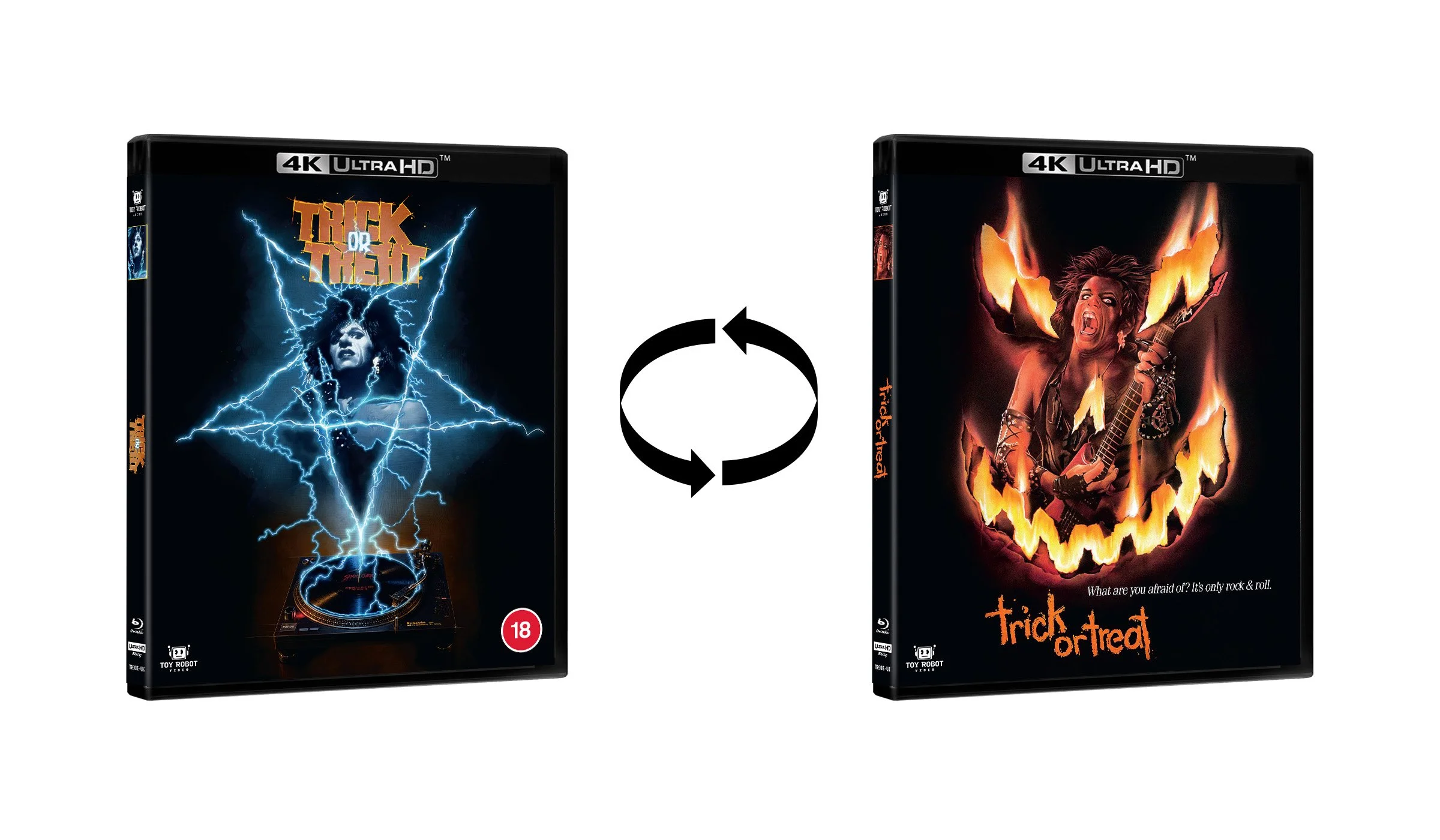
THE TOYROBOT SCORE
Trick or Treat – The Movie: ★★★½ / 5
Special Features: ★★★★ / 5
Overall Release Score: ★★★½ / 5
Trick or Treat remains a hugely enjoyable slice of ’80s horror nostalgia, and one that feels especially appropriate for this time of year. Its combination of heavy metal, supernatural horror, teenage rebellion and Satanic Panic satire gives it a personality all its own, while the Fastway soundtrack and the appearances from Gene Simmons and Ozzy Osbourne provide plenty of reasons to keep coming back.
It’s not without its shortcomings. The pacing can be sluggish, the horror takes a little while to get going, and the relatively tame gore may leave hardcore horror fans wanting something a bit more substantial. But those issues don’t erase the film’s considerable charm.
For me, this is the sort of title that reminds you why the VHS era remains such a fertile playground for cult-film fans. It’s a little rough around the edges, it wears its influences proudly, and it has enough personality to stand apart from the countless other horror films released during the decade.
Most importantly, it understands that heavy metal should be loud, theatrical and just a little bit dangerous — even if the actual body count could do with a little more splatter.
As with the previous reviews, I reserve the right for a potential to rise by another 0.5 once I can assess the complete productised package.
So dust off the denim, tease up that hair, crank the volume until the neighbours start threatening to call the police, and give Trick or Treat another spin. Just remember: if your favourite metal album starts playing backwards and telling you to commit murder, maybe stick to the lyrics printed on the sleeve.
Rock ’n’ roll will never die. And apparently, neither will Sammi Curr.
Release Information
Title: Trick or Treat (1986)
Distributor: ToyRobot Video
Release date: 5 October 2026
Catalogue code: TR005-UK
Barcode: 5027035030838
Format: Dual Format – 4K UHD and Blu-ray
Discs: 2
Country: USA
Genre: Horror / Comedy
Director: Charles Martin Smith
Cast: Marc Price, Tony Fields, Lisa Orgolini, Gene Simmons, Ozzy Osbourne
BBFC rating: 18
Aspect ratio: 1.85:1
Audio: DTS-HD 5.1, DTS-HD 2.0 Stereo
Language: English
Subtitles: English SDH
Runtime: 98 minutes
RRP: £29.99
Special Features:
Audio commentary with director Charles Martin Smith, moderated by filmmaker Mark Savage.
Audio interviews with writer/producer Michael S. Murphey and writer Rhet Topham, moderated by Michael Felsher.
Audio conversation with Paul Corupe and Allison Lang, authors of Satanic Panic: Pop-Cultural Paranoia in the 1980s.
Rock & Shock: The Making of Trick or Treat.
In The Spotlight: A Tribute to Tony Fields.
Horror’s Hallowed Grounds: The Filming Locations of Trick or Treat.
“After Midnight” music video.
Stills gallery featuring optional audio interview with photographer Phillip V. Caruso.
Theatrical trailers, TV spots, radio spots and press kit.
Source: ToyRobot Video / Fetch Publicity release information.