
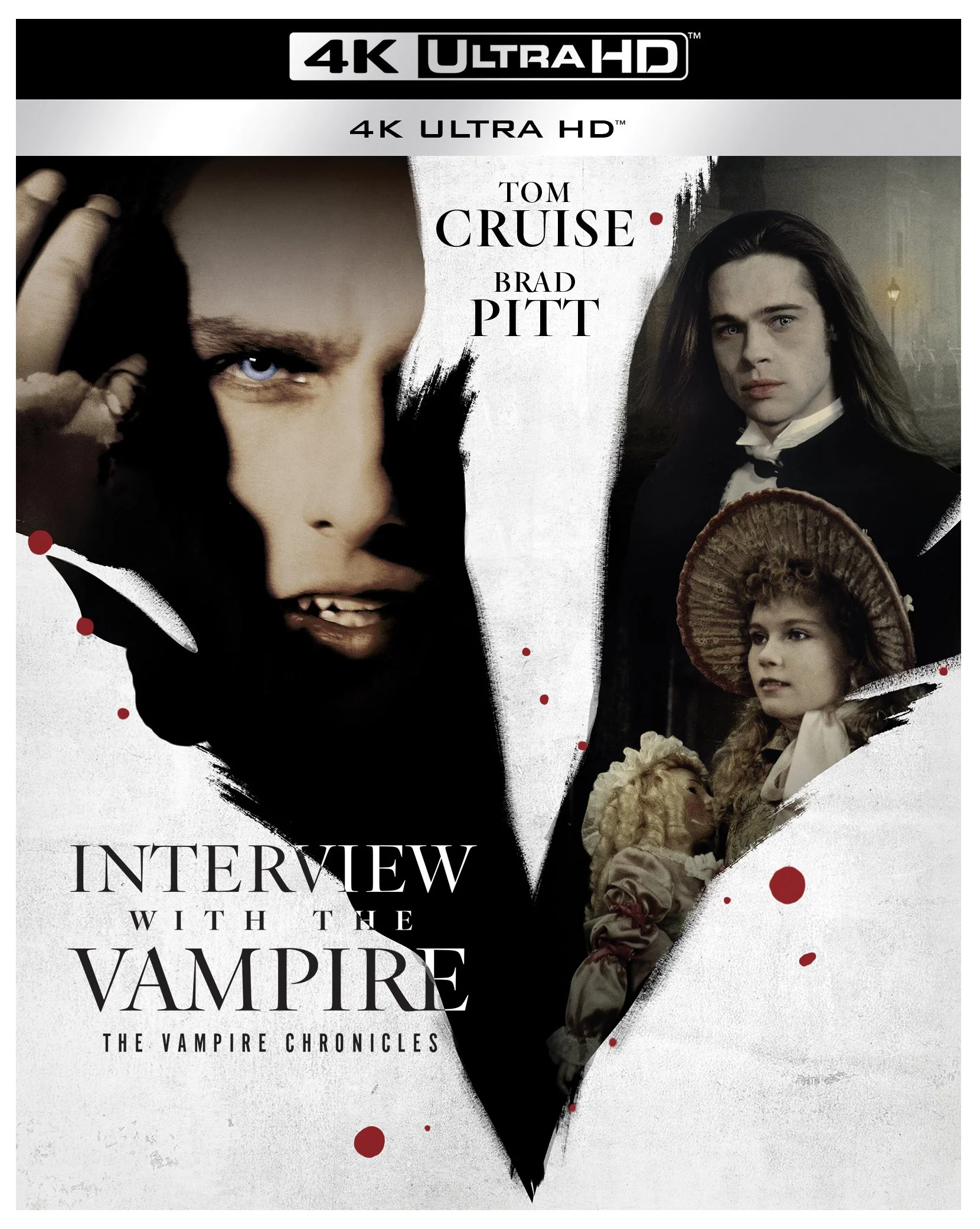
INTERVIEW WITH THE VAMPIRE (1994) – 4K UHD Release 5 October 2026
THE REVISIT
There are some films that feel completely different when you revisit them as an adult…Interview with the Vampire isn't necessarily one of them.
I first encountered Neil Jordan's adaptation of Anne Rice as a teenager, at precisely the age when the combination of vampires, blood, sex, death and an absolutely ridiculous cast felt like something Hollywood had made specifically for me. Three decades later, revisiting it for this new 4K release, I was genuinely surprised by just how well it holds up, because Interview with the Vampire occupies a fascinating place in the history of the modern vampire film.
Released in 1994, it arrived only two years after Francis Ford Coppola's Bram Stoker's Dracula, at a point when the vampire was being pulled away from the shadows and increasingly repositioned as a romantic, tragic and psychologically complicated figure. Rice's vampires weren't simply hunters stalking the night. They were immortal beings consumed by desire, loneliness, guilt, addiction and the crushing burden of simply continuing to exist….That was a pretty radical shift in emphasis.
And yet the film arrived at a fascinating moment. The vampire was about to go in a number of very different directions with Abel Ferrara's, grossly under-seen, The Addiction arriving the following year turning vampirism into an urban, philosophical metaphor for addiction and mortality, while From Dusk Till Dawn would follow in 1996 and gleefully blow the whole mythology apart in a spectacular explosion of guns, gore and exploitation cinema.
Then came True Blood, The Vampire Diaries, Twilight and countless other interpretations that further transformed the vampire from monster into romantic lead, tortured antihero, sexual fantasy and pop-culture icon.
Which raises an interesting question when looking back at Interview with the Vampire. Was Anne Rice's vision simply ahead of its time?
Perhaps not entirely, but audiences certainly seem to have needed time to catch up with what she was doing.
WHY THIS FILM STILL MATTERS
Anne Rice's Interview with the Vampire was always a strange proposition for Hollywood. Here was a vampire story where the horror wasn't necessarily about being hunted by the creature of the night. The horror was becoming one.
Louis de Pointe du Lac isn't transformed into a vampire and suddenly discovers the joys of immortality. He becomes increasingly horrified by what immortality requires of him. His relationship with blood becomes an addiction, his relationship with humanity becomes increasingly complicated and his relationship with Lestat becomes something between seduction, friendship, manipulation and toxic dependency.
Roger Ebert recognised this at the time, describing the film's greatest strength as its portrayal of vampirism as “an endless sadness” rather than a source of triumph. That distinction is crucial. The traditional vampire is a hunter. Rice's vampire is also the hunted by his own conscience, his appetites and the passage of time.
That idea has become much more familiar in the decades since.
By the time HBO's True Blood arrived in 2008, television audiences were perfectly comfortable with vampires having sex, relationships, political agendas, personal trauma and existential crises. AMC's Interview with the Vampire, meanwhile, has taken Rice's ideas even further, making explicit much of the sexuality and emotional complexity that the 1994 film largely communicated through implication. Its first season was met with strong critical enthusiasm, while AMC reported that the premiere became its biggest new-series launch at the time.
That makes the 1994 film increasingly interesting in retrospect. It wasn't the first movie to humanise vampires, but it was one of the most lavish attempts to take that idea seriously while still delivering the spectacle audiences expected from a major studio horror production. And remarkably, it still works.
THE DIRECTOR, THE CAST & THE CRAFT
The casting of Interview with the Vampire remains one of its great achievements. Neil Jordan was coming off The Crying Game when he took on the project, and he brings precisely the kind of gothic romanticism the material requires, but the film lives or dies on its central trio.
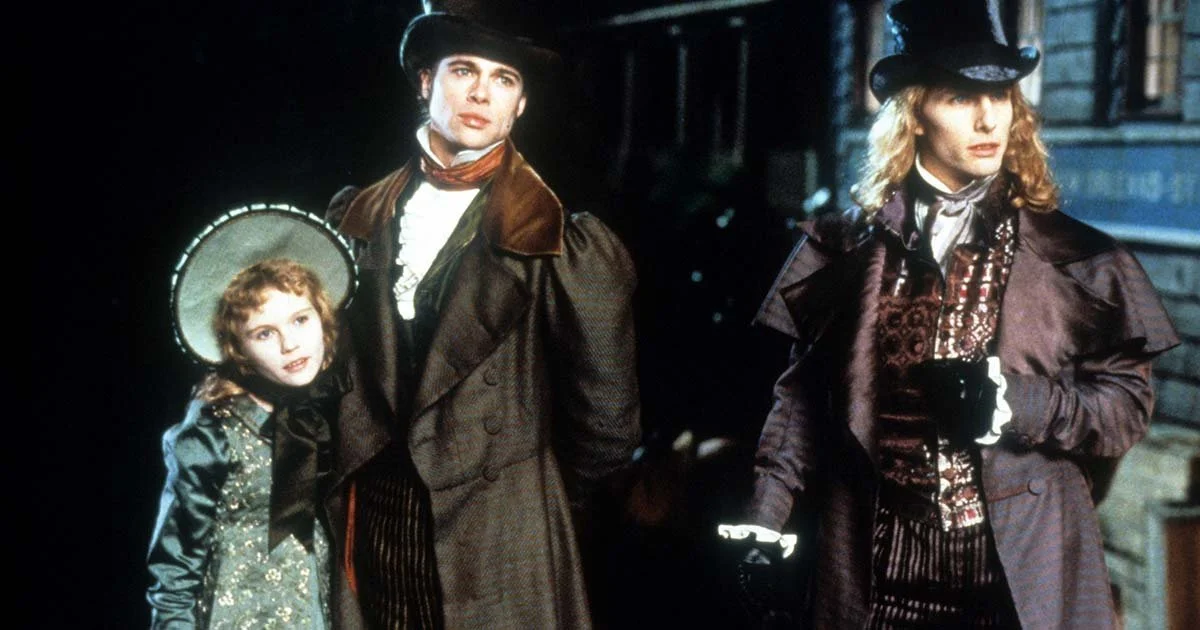
Brad Pitt's Louis provides the emotional and philosophical centre. He is essentially the reluctant vampire, trapped between his desire to remain connected to humanity and the reality that he has become something fundamentally different.
Then there is Kirsten Dunst as Claudia.
Watching Dunst's performance again is one of the biggest revelations of revisiting the film. Claudia is horrific precisely because she looks like a child but thinks, feels and behaves like someone who has lived for decades. Dunst somehow manages to convey both things simultaneously, creating one of the most memorable child performances in 1990s genre cinema.
And then there is Tom Cruise….Tom Cruise playing a villain. That alone feels slightly bizarre when viewed from the perspective of his modern career.
Cruise has played antagonistic or morally compromised characters elsewhere, Michael Mann’s Collateral being the obvious later example, but Lestat remains one of the rare occasions where one of Hollywood's biggest stars was allowed to fully embrace being the monster. And much like all Cruise roles he absolutely commits to it.
Cruise's Lestat is vain, theatrical, narcissistic, manipulative and occasionally hilarious. He isn't simply evil; he enjoys being evil. He understands the power of his immortality and revels in the freedom it gives him.
That casting was controversial at the time, with Rice herself initially objecting to Cruise's involvement before eventually embracing the performance. Contemporary criticism also questioned the casting, while later reassessments have increasingly recognised just how good Cruise is in the role. And watching it now, the performance feels like one of the great examples of an actor happily weaponising his own movie-star persona.
The supporting cast is extraordinary too with Christian Slater providing the human perspective as the journalist Daniel Molloy, Antonio Banderas bringing flamboyance and ambiguity to Armand. Stephen Rea's Santiago is equally memorable, while the film's ensemble helps create the sense of a much larger vampire society lurking beneath the story. It is, quite simply, ridiculous casting in the best possible way.
And then there is the production itself.
Philippe Rousselot's cinematography and Dante Ferretti's production design are magnificent. The New Orleans streets, plantation interiors, Parisian locations, theatres, crypts and catacombs create a world that feels simultaneously beautiful, decaying and completely removed from reality. This is gothic cinema with serious money behind it.
The film was nominated for two Academy Awards, including Best Original Score and Best Art Direction, and you can understand why simply by looking at it. The score from Elliot Goldenthal completes the atmosphere, giving the film an operatic quality that suits both the grandeur and the melancholy.
Everything is oversized, the sets, the costumes, the performances, the emotions, the blood…And somehow it all works.
THE VAMPIRE AS ADDICTION
One of the things that feels particularly interesting about Interview with the Vampire now is its relationship with addiction. Louis doesn't simply hunger for blood. He struggles with it.
The vampire's existence becomes an endless cycle of desire, consumption, guilt and relapse. He can attempt to resist, but eventually the hunger wins. That idea feels remarkably contemporary when viewed alongside the vampire films that followed.
Abel Ferrara's The Addiction would make that metaphor considerably more explicit the following year, using vampirism as a philosophical and psychological exploration of addiction, mortality and human corruption.
Then From Dusk Till Dawn effectively looked at the vampire myth from the opposite direction. Forget existential guilt, forget immortal loneliness, here's a vampire….here's a shotgun…get on with it.
Robert Rodriguez's film deliberately smashes together crime cinema and vampire exploitation, transforming the vampire from tragic romantic figure back into a creature designed to be slaughtered in spectacular fashion and that contrast demonstrates just how flexible the vampire had become by the middle of the 1990s.
And Interview with the Vampire sits right at the centre of that transformation.
THE 4K EXPERIENCE
If there is one aspect of this release that genuinely took me by surprise, it is just how bloody gorgeous this film looks in 4K. This is one of those upgrades where the source material seems almost tailor-made for the format, the detail is superb.
Rousselot's cinematography has always been one of the film's greatest strengths, but the additional resolution allows the textures of the production design, costumes, faces and locations to become considerably more apparent…And then there is the colour.
The deep reds of blood, the rich browns and golds of the interiors, the cold blues and blacks of the night-time sequences and the muted colours of the New Orleans streets all benefit enormously from the presentation.
The film has an almost painterly quality, and the 4K restoration allows that quality to breathe. The shadows are particularly impressive.
Interview with the Vampire spends an enormous amount of time in darkness, but this is not simply darkness for the sake of hiding things. The lighting creates depth and atmosphere, and the improved presentation gives those darker scenes considerably more texture without stripping away their gothic mood and the image retains the character of a film print rather than looking scrubbed and clinically digital.
And the sound is equally impressive.
The Dolby Atmos-TrueHD presentation gives Elliot Goldenthal's score considerably more space, while the dialogue, effects and carefully constructed atmosphere all benefit from the improved audio presentation. Warner Bros' release presents the film in 2160p Ultra HD at 1.85:1 with Dolby Atmos-TrueHD, alongside the Blu-ray.
For a film that relies so heavily on atmosphere, music and production design, this is an extremely satisfying upgrade. More importantly, it confirms something I wasn't entirely expecting when I put the disc on. This film still looks incredible.
SPECIAL FEATURES – INTO THE DARKNESS
Warner Bros has supplemented the new 4K presentation with a mixture of new and existing material.
The two new features are particularly welcome.
Eternal Night and Deadly Light sees Neil Jordan and editor Mick Audsley discussing the film's approach to cinematography and the gothic romanticism created alongside Philippe Rousselot.
Interview with the Vampire: Creating the World takes a closer look at the production design, with Jordan and Dante Ferretti discussing the sets, locations and costumes that helped construct the film's elaborate world.
The existing material remains useful too, including Neil Jordan's commentary, Anne Rice's introduction with Jordan and Antonio Banderas, In the Shadow of the Vampire and Lestat, Louis and the Vampire Phenomenon, alongside deleted scenes.
For a film where the physical world is so important to its identity, the additional production material is particularly valuable.
FINAL THOUGHTS
Revisiting Interview with the Vampire after first seeing it as a teenager has been one of the more pleasant surprises of this latest run of 4K releases. I expected nostalgia but what I didn't necessarily expect was to find a film that still holds up this well.
It is beautifully made, superbly cast, lavishly produced and, despite the occasional indulgence, remarkably confident in its own strange vision and perhaps most importantly, it feels like a film that arrived at exactly the right moment, and possibly a little too early.
The vampire was beginning to change.
Coppola had brought the gothic romantic vampire back to the big screen. Rice had transformed that creature into a figure of addiction, sexuality, grief and existential despair. Ferrara would push the metaphor further. Rodriguez would gleefully turn the vampire into an excuse for a gore-soaked action movie. And eventually television would embrace the complicated, sexy, tragic vampire as an entire dramatic universe.
Seen in that context, Interview with the Vampire feels less like an isolated adaptation and more like a crucial part of that transition.
Anne Rice's subsequent adaptations haven't always received the same level of critical affection, but the persistence of her characters and ideas is undeniable. The recent AMC series demonstrates just how much dramatic potential remains within this mythology, and its success suggests that audiences may now be far more receptive to the vision Rice was presenting all those years ago.
And then there is that cast.
Brad Pitt.
Tom Cruise.
Antonio Banderas.
Stephen Rea.
Christian Slater.
Kirsten Dunst.
It's an absolutely ridiculous collection of talent and at the centre of it all, Cruise's Lestat remains the surprise package. Seeing one of the biggest movie stars on the planet lean so enthusiastically into playing an unapologetic monster is still a joy. However, the biggest revelation for me is simply that, three decades after I first watched it, I still think this is a bloody great vampire movie.
And in this stunning new 4K presentation, it may never have looked better.
Score: 4.5/5
BLURAY INFORMATION FROM PR:
INTERVIEW WITH THE VAMPIRE: THE VAMPIRE CHRONICLES
STARRING TOM CRUISE, BRAD PITT, ANTONIO BANDERAS, STEPHEN REA, CHRISTIAN SLATER, AND KIRSTEN DUNST WILL BE AVAILABLE FOR THE FIRST TIME IN 4K RESOLUTION WITH HIGH DYNAMIC RANGE (HDR)
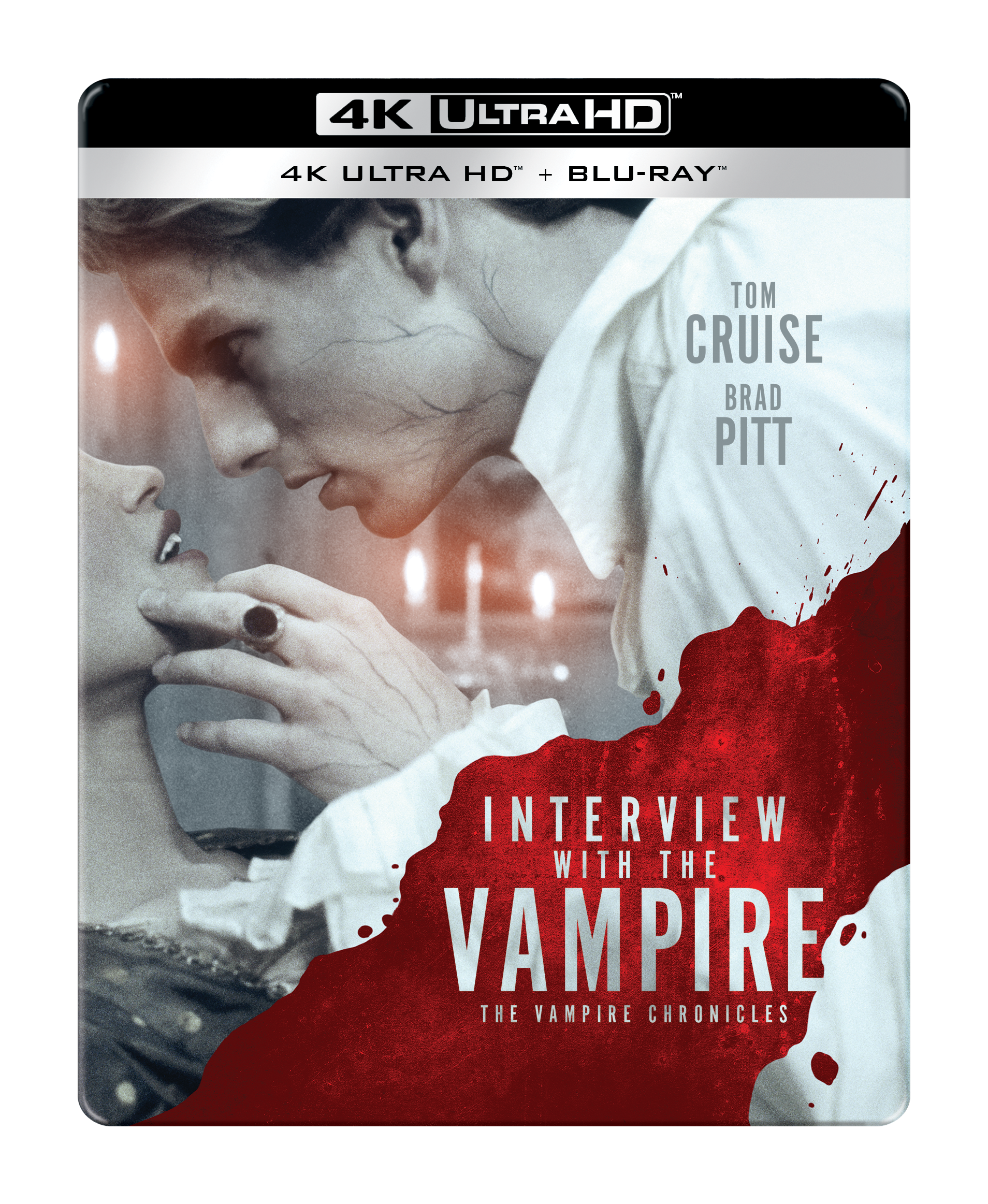
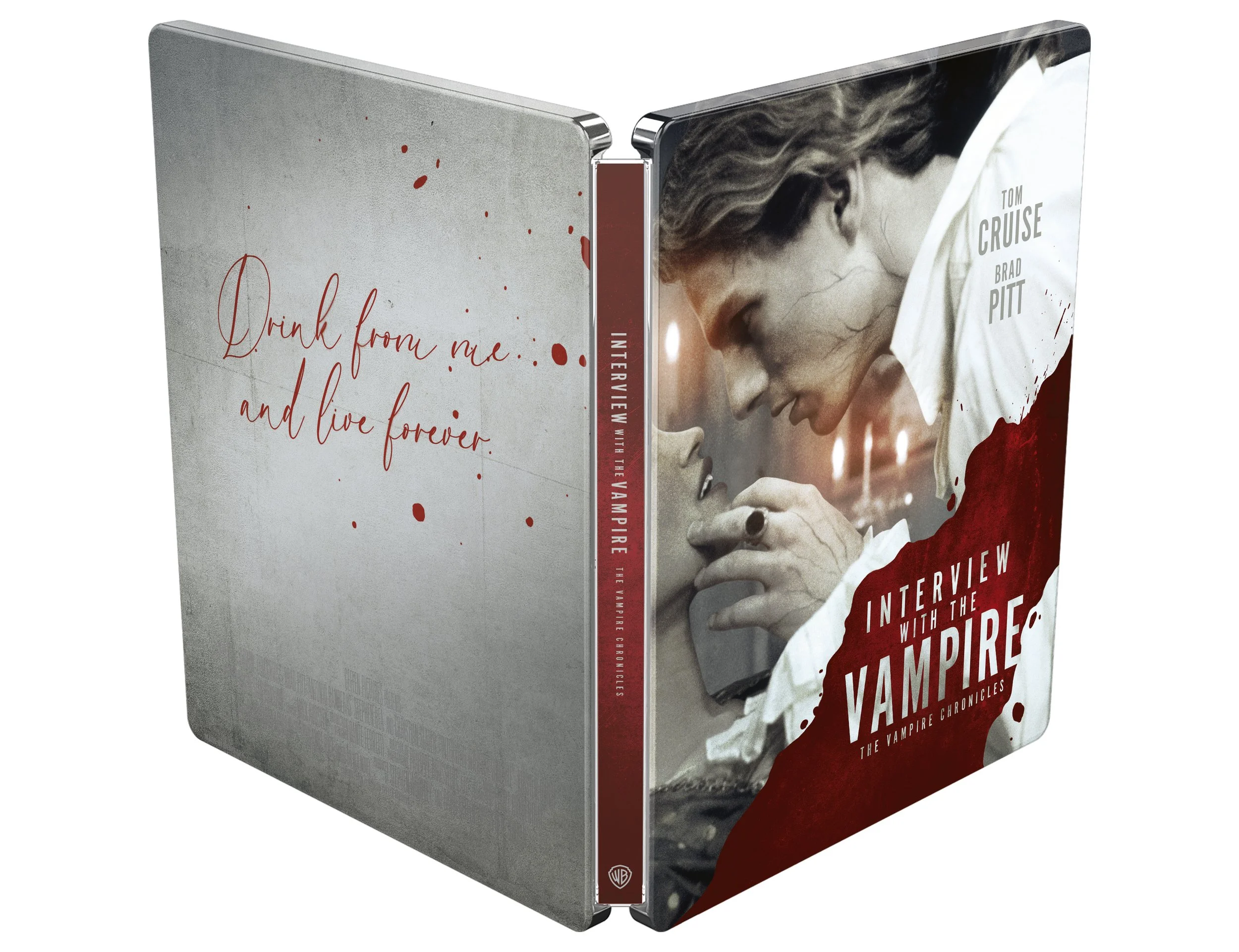
AVAILABLE ON 4K ULTRA HD BLU-RAYTM AND STEELBOOK ON OCTOBER 5, 2026
Interview with the Vampire will be available for purchase on 4K UHD Blu-ray and SteelBook on October 5. Featuring an all-star cast led by Tom Cruise and Brad Pitt and directed by Academy Award winner Neil Jordan (“The Crying Game”), the newly remastered film will also include new bonus content featuring filmmakers reflecting on the making of the film over 30 years later.
Based on the blockbuster novel of the same name by Anne Rice, the film features an all-star ensemble cast, including Academy Award winners Tom Cruise and Brad Pitt, Academy Award nominees Antonio Banderas, Stephen Rea, and Kirstin Dunst along with Christian Slater. The film was nominated for Best Original Score and Best Art Direction at the 67th Academy Awards.
About the Film:
In late 20th-century San Francisco, a 200-year-old vampire tells his story--of desire, love, yearning, grief, terror, ecstasy--to a young reporter, weaving the history that has come to be known as Interview with the Vampire.
Interview with the Vampire 4K Ultra HD Blu-ray Disc contains the following new and existing special features:
Eternal Night and Deadly Light (NEW)
Director Neil Jordan and film editor Mick Audsley reveal the approach to the cinematography of Interview with the Vampire with a focus on the gothic romanticism achieved by director of photography Philippe Rousselot
Interview with the Vampire: Creating the World (NEW)
Step inside the darkly beautiful world of Interview with the Vampire with director Neil Jordan and production designer Dante Ferretti as they unveil the art of the detailed sets, the augmented locations and the exquisite costumes of the film
Deleted Scenes
Commentary with director Neil Jordan
Introduction by Anne Rice, Neil Jordan, and Antonio Banderas
In the Shadow of the Vampire
Lestat, Louis and the Vampire Phenomenon
BASICS
4K Ultra HD Aspect Ratio: 2160p Ultra High Definition 16x9 1.85:1
4K Ultra HD Languages: English 5.1; Dolby Digital: Castilian Spanish 5.1, Canadian French 5.1, Czech 2.0, German 5.1, Italian 5.1, Latin Spanish 2.0 (Mono), Parisian French 5.1, Polish 5.1
4K Ultra HD Subtitles: English SDH, German SDH, Italian SDH, Castilian Spanish, Complex Chinese, Czech, Danish, Dutch, Finnish, Korean, Latin Spanish, Norwegian, Parisian French, Polish, Swedish
4K Ultra HD Audio: Dolby Atmos-TrueHD; DTS-HD Master Audio; Dolby Digital
Blu-ray Aspect Ratio: 1080p High Definition 16x9 1.85:1
Blu-ray Languages: English 5.1, French 5.1, German 5.1, Italian 5.1, Spanish 5.1
Blu-ray Subtitles: English, Danish, Dutch, Finnish, French, German, Italian, Spanish, Norwegian, Portuguese, Swedish
Blu-ray Audio: DTF-HD Master Audio
Run Time: 123 minutes
Rating: 15
Physical Street Date: October 5, 2026