
TOYROBOT VIDEO REVIEW #002 - ROARING FIRE (1981) - Released 7th September 2026
Sonny Chiba, Young Sanada, A 130-Carat Diamond & One Extremely Confused Monkey
Welcome to ToyRobot Video Review #002, and if Guyver: Dark Hero was our introduction to ToyRobot's particular brand of cult-film madness, then Roaring Fire is where we discover that the label isn't remotely interested in staying in one genre for longer than approximately twelve seconds.
Because what exactly is Roaring Fire?
Martial arts movie? Crime thriller? Comedy? Family drama? Revenge movie? Hong Kong action spectacular? Sonny Chiba showcase? Hiroyuki Sanada star vehicle? Abdullah the Butcher vehicle?
The answer is apparently…..YES.
And that makes this a wonderfully strange second title for the ToyRobot collection.
Released in Japan in 1981 as Hoero! Tekken, Roaring Fire comes from Toei, the Japanese studio behind an enormous amount of genre cinema and, crucially here, the home of the Japan Action Club, the training ground that helped produce several of the film's major stars.
The film was directed by Norifumi Suzuki, a veteran filmmaker whose career could move from martial arts to exploitation to sex films to action comedy without apparently stopping for a coffee in between. He had already worked with both Sonny Chiba and Hiroyuki Sanada, and Roaring Fire became another opportunity to throw the pair together and see what happened.
What happened was...this.
WELCOME TO THE TOEI CINEMATIC UNIVERSE
Toei is arguably the first thing to understand about Roaring Fire, because if you're coming to the film expecting a conventional Japanese action picture, the sheer amount of stuff being thrown at the screen can be a little bewildering.
Toei had long been a powerhouse of Japanese popular cinema, with a particular reputation for genre filmmaking. By the time Roaring Fire arrived, Sonny Chiba had already become an international martial-arts icon through films including The Street Fighter, while Etsuko Shihomi had established herself as one of Japan's premier female action stars.
And then there's the young man in the middle of all this…Hiroyuki Sanada.
Yes….That Hiroyuki Sanada!
The future star of The Last Samurai, Sunshine, 47 Ronin, John Wick: Chapter 4 and, of course, Shōgun is here looking considerably younger, considerably more energetic and considerably more likely to solve a family dispute by kicking someone through a window.
Sanada had been a member of Sonny Chiba's Japan Action Club and was effectively Chiba's protégé. Roaring Fire arrives at a fascinating point in his early career, when he was moving from child actor into full-blown action star territory.
And you can see why Chiba took an interest. Sanada is ridiculously physical.
He has the screen presence, the athleticism and the willingness to throw himself into the action that would eventually become such a huge part of his international career.
Except here he's doing it while wearing some magnificently '80s hair.
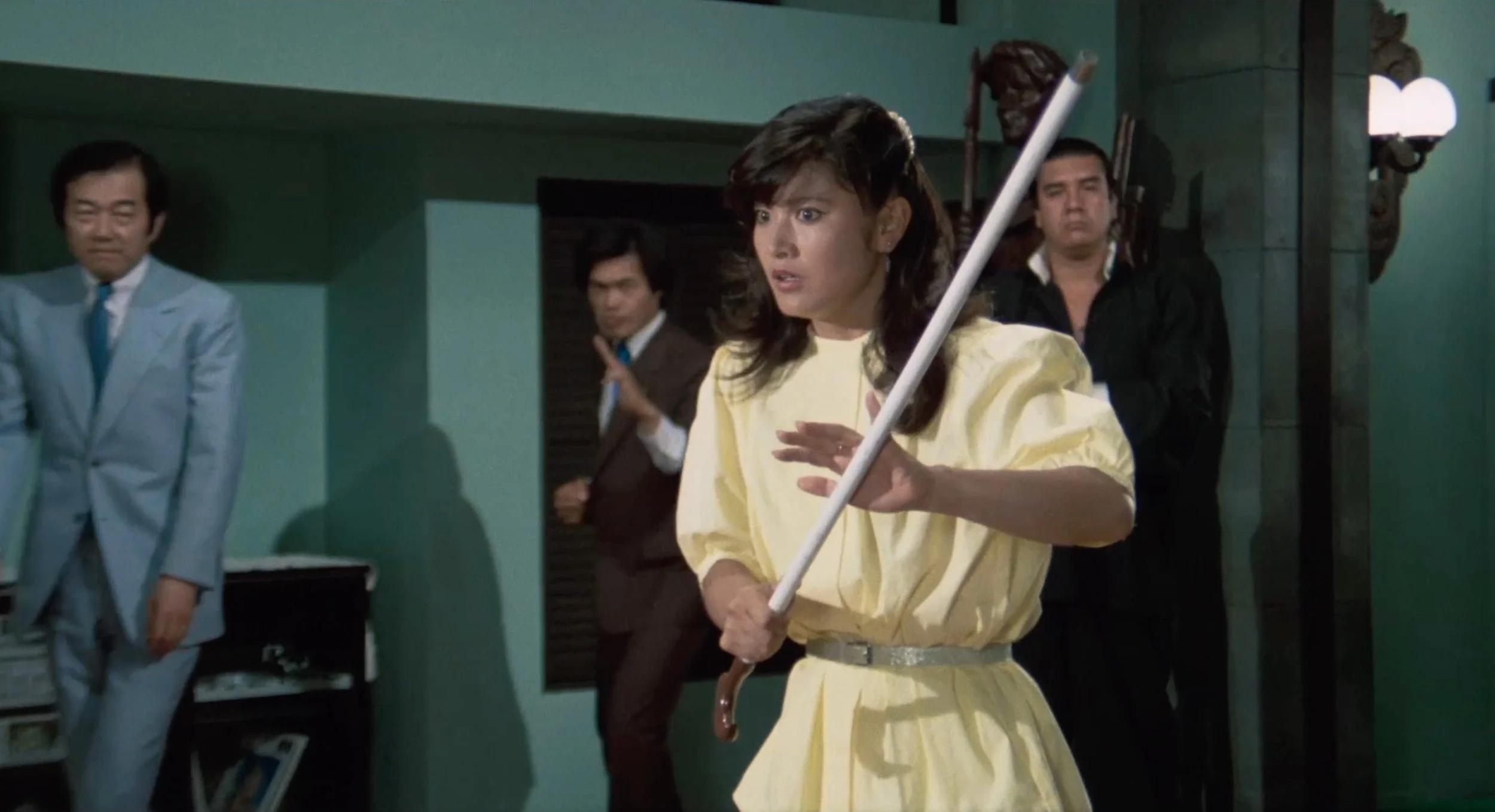
THE PLOT, SUCH AS IT IS…
Joji is a Texas-raised rancher who discovers on his adoptive father's deathbed that he has a twin brother and a sister in Japan.
Because apparently nobody thought this was information worth mentioning earlier.
Joji heads to Japan to find his brother. Unfortunately, his brother has been murdered. Naturally.
He then meets his sister, gets involved with a dodgy uncle, discovers criminal enterprises, becomes embroiled in a plot involving a 130-carat diamond known as the Queen of Sheba, encounters Sonny Chiba in the role of an Interpol agent/magician-type character and eventually finds himself embroiled in a sprawling revenge story that takes us from Japan to Hong Kong and back again.
Oh, and Abdullah the Butcher is involved.
At this point, if you're wondering whether Roaring Fire is perhaps a little difficult to explain to somebody who hasn't seen it, congratulations…you understand the movie.
ENTER SONNY CHIBA
If Hiroyuki Sanada is the young star in waiting, Sonny Chiba is the established legend walking into the room and immediately making it his own.
Chiba had already become one of the defining faces of Japanese martial-arts cinema, particularly internationally thanks to The Street Fighter and its sequels.
Here, he's playing Shunsuke Tachizawa or “Mr. Magic”, as the English-language material would have it.
And honestly, the name tells you everything you need to know.
This isn't necessarily Chiba doing his most serious, intimidating action-hero performance.
He's having fun. He's charismatic. He's eccentric.
And when the film wants to remind you that this man can absolutely kick seven shades of shit out of somebody, it lets him do exactly that. Chiba also served as the film's action director, which makes perfect sense because the fight scenes are among the film's strongest material.
Then there's Etsuko Shihomi, another Japan Action Club graduate and a major figure in Japanese martial-arts cinema. Shihomi had already established herself through films such as the Sister Street Fighter series, and she's more than capable of holding her own alongside Chiba and Sanada.
The result is basically an early-'80s Japanese action fan's fantasy casting. Chiba, Shihomi, Sanada…And then...
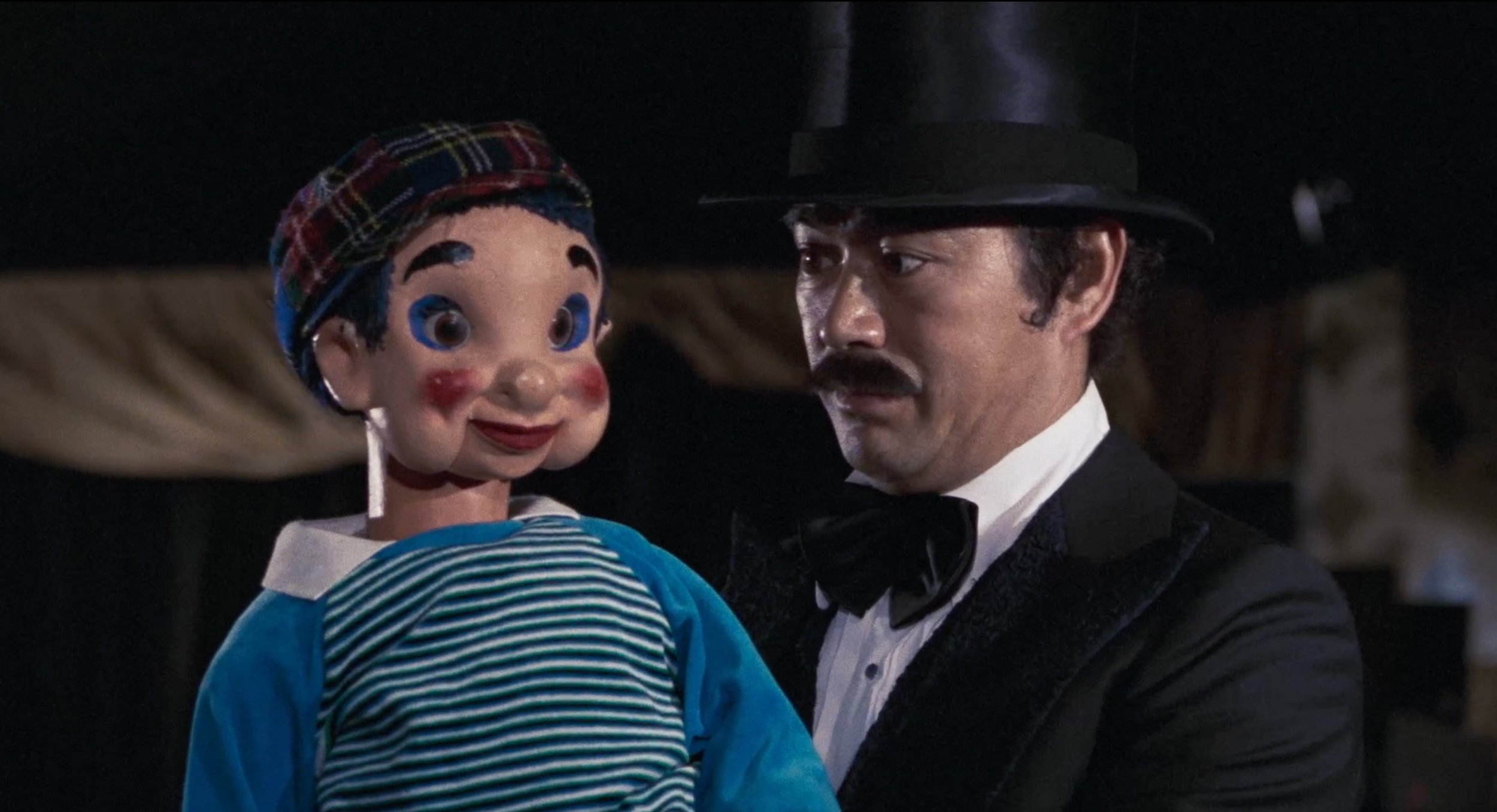
ABDULLAH THE BUTCHER!
WHAT? Yes. Professional wrestler (and nightmare machine to this young reviewer) Abdullah the Butcher, real name Lawrence Shreve, turns up as Spartacus.
And if you're familiar with Abdullah's wrestling persona, seeing him in a Japanese martial-arts movie is already strange enough.
But then Roaring Fire decides to make him...the good guy….Sort of.
Abdullah was enormously popular in Japan and had a reputation for being one of professional wrestling's great larger-than-life villains. Here, however, he's given a much more sympathetic role, complete with the sort of oversized performance that suggests somebody told him, “Just be Abdullah.”
So he does. And thank God for that.
His presence gives the film another bizarre international flavour, particularly because Roaring Fire isn't trying to hide the fact that he's a wrestler. He's essentially dropped into this Japanese action movie like a human wrecking ball.
And suddenly we're watching Sonny Chiba and Abdullah the Butcher sharing screen space.
Cinema was different in 1981.
THE TONAL WHIPLASH
This is where Roaring Fire becomes genuinely fascinating, because Suzuki cannot seem to decide what movie he's making.
And I mean that affectionately.
The opening sections have a strange, almost comic-book quality. The family mystery develops alongside increasingly ridiculous comedy sequences, eccentric supporting characters and some wonderfully strange visual gags.
Then, seemingly without warning, the film remembers, “Oh yes. REVENGE.”
And suddenly everything becomes more serious.
People get killed.
People get betrayed.
Characters suffer.
The action becomes more brutal.
The music kicks in.
Sanada starts looking intensely miserable.
And you're sitting there thinking, weren't we just watching a monkey steal somebody's bikini?
Yes….Yes, we were.
The tonal shifts are probably the film's biggest problem if you're looking for consistency, but they're also arguably its secret weapon.
There is something wonderfully old-school about a film refusing to respect genre boundaries.
Modern filmmaking often wants to establish its tone and maintain it.
Suzuki apparently responds, “Fuck that. Put a joke in.”
And then five minutes later, “Now kill someone.”
THE HUMOUR HAS NOT EXACTLY AGED LIKE FINE WINE
There is another problem. Some of the comedy simply hasn't aged particularly well.
There are jokes here that are so broad, dated and occasionally uncomfortable that you can practically hear the laughter track from another dimension.
This is one of those films where you have to distinguish between, “This is deliberately ridiculous.” and “I'm not entirely sure the filmmakers realise how ridiculous this is.”
The line between those two things is occasionally thinner than Sanada's patience.
The comedy can be hilarious because of the sheer absurdity of the situation, but there are also moments where you're watching and thinking, “Right... we're not doing that joke again, are we?”
Unfortunately, Roaring Fire occasionally does that joke again. And again. And again.
It's very much a product of its era and should be approached as such and that doesn't make every gag work.
It just makes some of them considerably easier to understand historically than to actually laugh at.
CAMEOS, CAMEOS EVERYWHERE
One of the pleasures of Japanese genre cinema from this period is spotting familiar faces and the cast list is absolutely loaded with supporting players, stunt performers and genre regulars.
There's Seizō Fukumoto, who had an extensive career as a stunt performer and action actor and would become particularly famous for his work as a sword-fighting stunt performer. There's Rikiya Yasuoka, who would go on to appear in films including Tampopo. And then there are the wrestling connections, including Great Kojika, alongside Abdullah.
They're not necessarily traditional “blink and you'll miss them” celebrity cameos in the modern Marvel sense, but they contribute to the feeling that Suzuki has assembled an enormous pool of Japanese genre talent and simply decided to throw everybody into the same movie.
Which is exactly the kind of casting philosophy I can get behind.
WHEN ROARING FIRE BECOMES A HONG KONG MOVIE
One of the film's most interesting elements is its movement between Japan and Hong Kong.
The movie's international flavour is reinforced by the Hong Kong locations and the action-heavy sequences, giving parts of Roaring Fire the feel of a Hong Kong martial-arts production.
It makes the film feel slightly ahead of its time in places. And then you have Sanada.
Here is an actor who would eventually become a major international action star, already performing with the kind of physical commitment that would later serve him so well. There are some impressive stunts throughout, and the action sequences are easily where the film is most successful.
Chiba's involvement in the choreography is obvious.
When the film stops trying to be funny and lets the fighters do what they were hired to do, Roaring Fire can be bloody good fun.
THE 130-CARAT ELEPHANT IN THE ROOM
The actual story is probably where I struggle most. There is a lot going on. Sometimes too much.
Family secrets.
Twins.
Murder.
Interpol.
Gangsters.
Diamonds.
Hong Kong.
Drug smuggling.
Revenge.
Magic.
Wrestling.
Monkeys.
Nuns.
And at one point you're basically waiting for somebody to announce, “AND NEXT WEEK... GODZILLA!”
The narrative is less a straight line and more a drunken shopping trolley careening through several different genres. But again, that's part of its personality. Roaring Fire isn't elegant. It isn't particularly subtle.
And it isn't remotely interested in explaining itself at the speed modern audiences might expect.
Instead, it just keeps moving and sometimes that works.
Sometimes it leaves you staring at the screen trying to reconstruct the previous fifteen minutes like you're solving a particularly violent crossword.
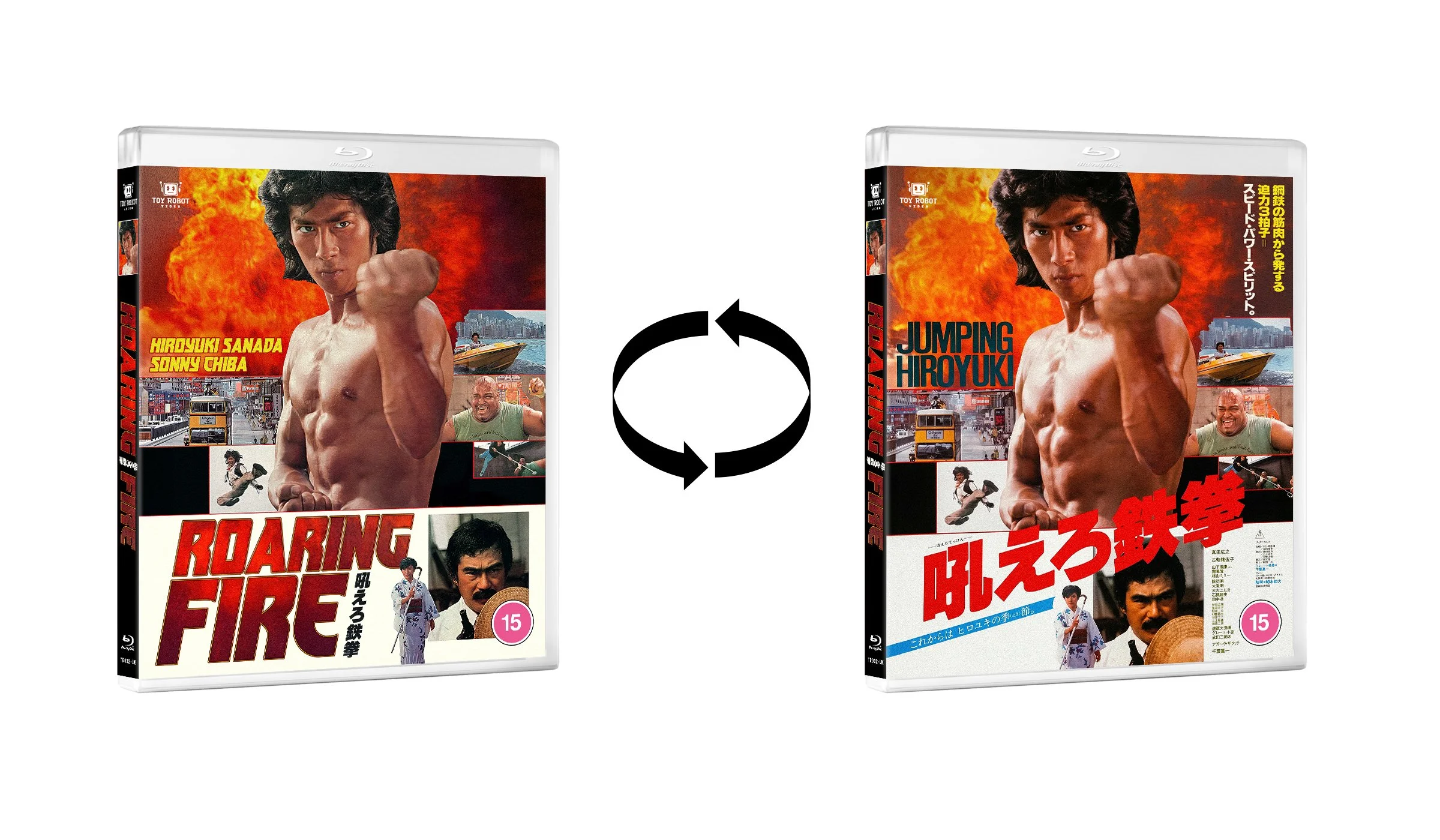
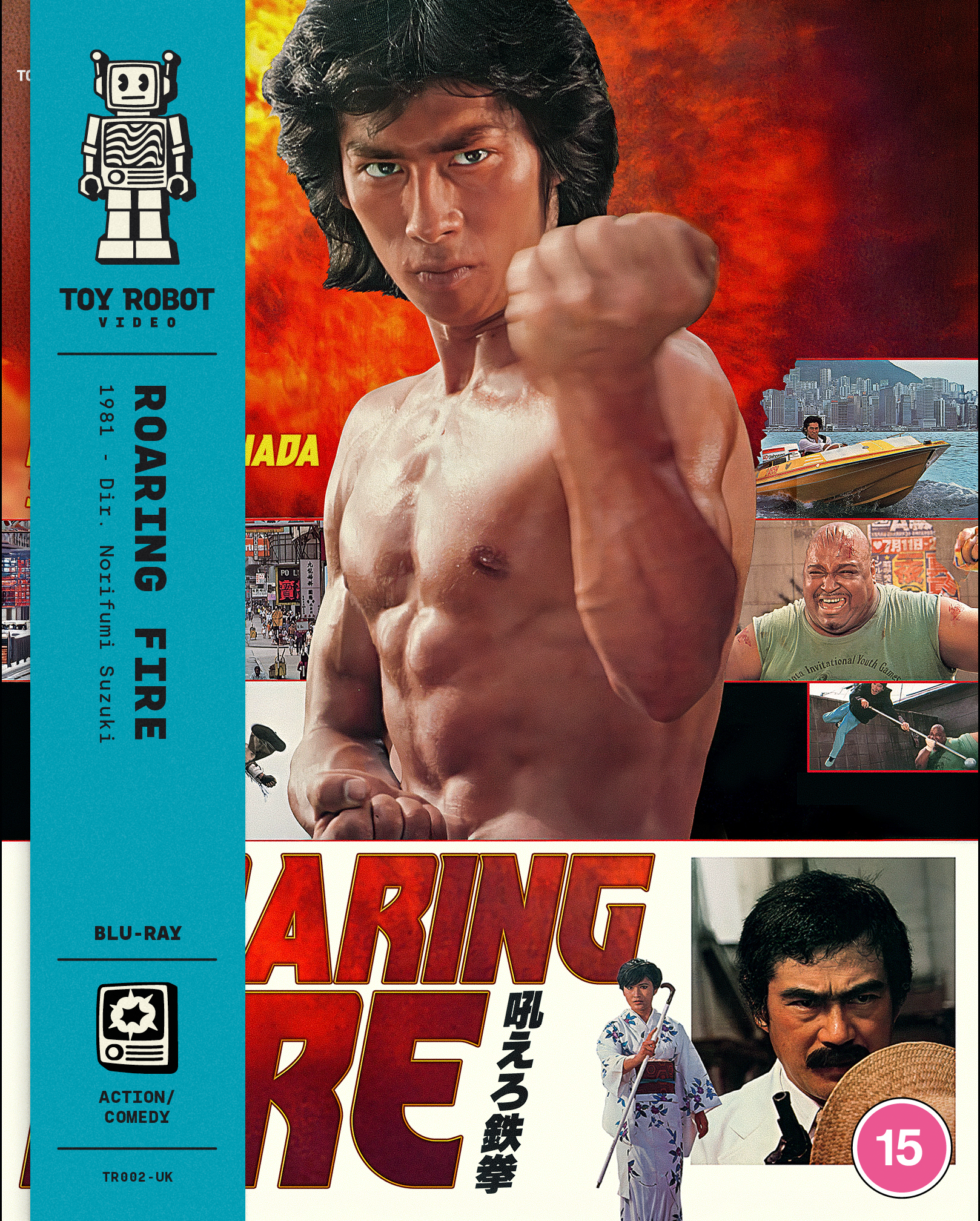
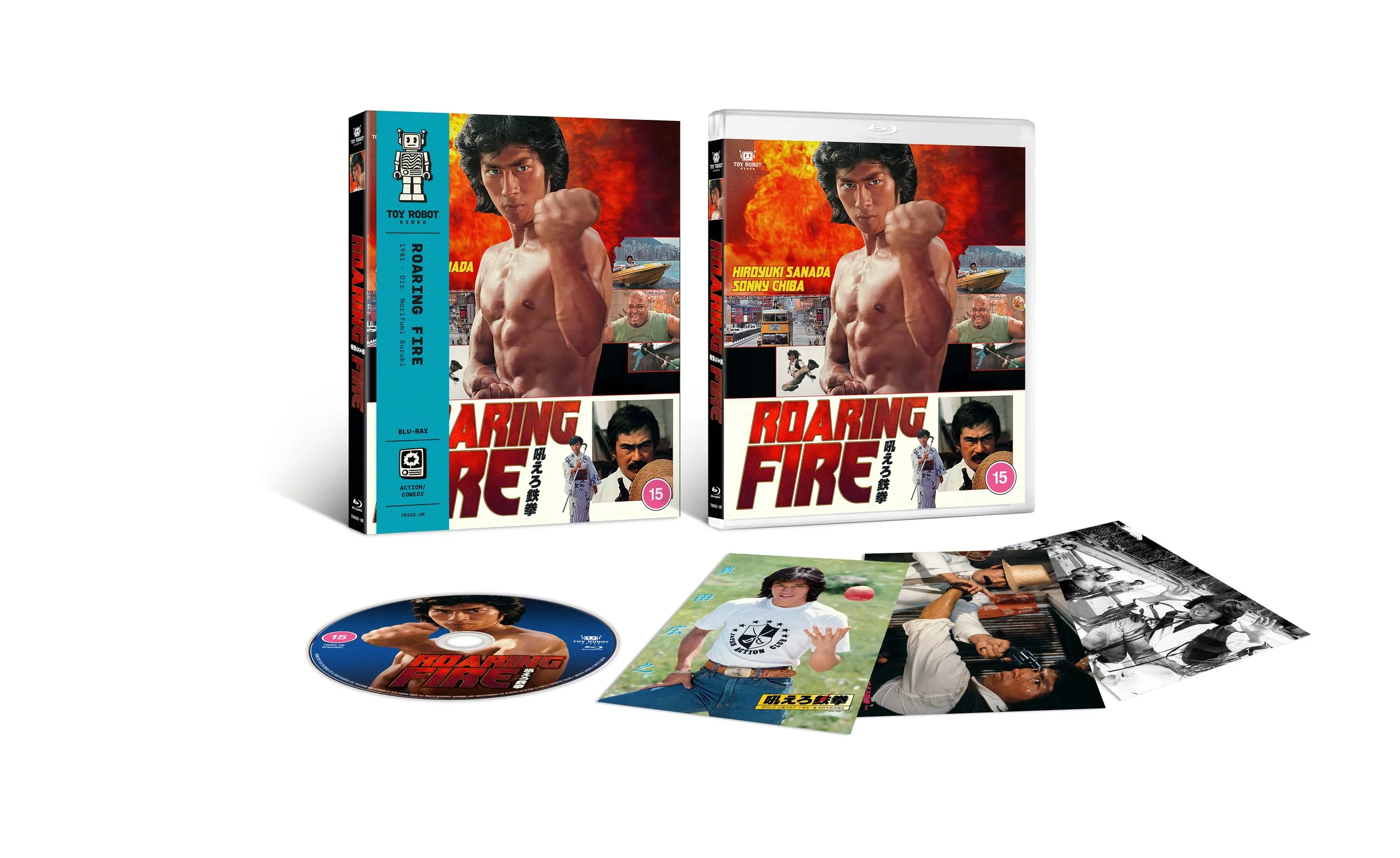
THE UK BLU-RAY: FINALLY!
And this is where the ToyRobot release becomes particularly important. According to ToyRobot's own release information, Roaring Fire is making its UK Blu-ray debut and is presented uncut for the UK.
That's rather remarkable when you consider the film's history.
The movie did receive a brief US theatrical release through New Line Cinema in 1982, and a Thorn/EMI home-video release followed in the early-'80s video market. The Thorn/EMI VHS is therefore an important part of the film's UK home-video history.
What I haven't been able to establish conclusively is a surviving BBFC cut list detailing precisely which shots were removed from the previous UK presentation. And I'd rather say that than repeat some wonderfully fanciful reddit thread as fact.
What matters for this release is that ToyRobot is explicitly presenting Roaring Fire uncut for UK audiences and after decades of VHS-era obscurity, that's a pretty damn good reason to celebrate.
THE TOYROBOT EXTRAS
And once again, ToyRobot has understood what makes these releases worthwhile as without those extras the movie itself gets 2½ out of 5 from me.
Thos special features, however, add a considerable amount of value.
The new commentary from film historian Brian Bankston is exactly the kind of contextual material that a film like this needs.
Then there's Akihiko Ito discussing Sonny Chiba in Fire-storm!, which gives us an opportunity to look beyond the larger-than-life persona and into the man and actor behind one of Japanese cinema's most recognisable action stars.
James Mudge provides A Roaring Success, a retrospective on the film, while Chris Lines tackles the extraordinary life and times of Abdullah the Butcher in Wrestle with Fire.
And then Clément Rauger gets to investigate the film's unique combination of comedy and action in A Buffet of Comedy and Action.
Frankly, that's a pretty good description of the film itself. A Buffet of Comedy and Action.
Just add a diamond and a monkey. The package also includes the theatrical trailer and TV spot.
FINAL VERDICT
I am genuinely glad I've finally seen Roaring Fire. Is it great?…No.
Is it consistent?…Absolutely fucking not.
Does the humour occasionally make you want to travel back to 1981 and have a quiet word with the writers?…Yes.
But is it entertaining?…Oh, absolutely.
This is one of those films where the imperfections are almost inseparable from the experience.
The cast is fantastic.
The action is often excellent.
Sanada is already demonstrating the physical presence that would eventually make him an international star.
Chiba is Chiba.
Shihomi is excellent.
Abdullah the Butcher is... well...
Abdullah the fucking Butcher.
The movie lurches between family melodrama, comedy, martial arts, crime thriller and Hong Kong action cinema with absolutely no concern for whether any of those ingredients should actually belong in the same bowl.
And yet there is something incredibly endearing about it. It's messy. It's weird. It's dated. It's occasionally hilarious for entirely the wrong reasons.
And every now and then it suddenly delivers a piece of action that reminds you exactly why Japanese genre cinema of this period deserves to be rediscovered.
THE TOYROBOT SCORE
Roaring Fire – The Movie: ★★½ / 5
Special Features: ★★★ / 5
Overall Release Score: ★★★ / 5
Once my review copy arrives, I'll be taking a closer look at the physical release and that could potentially push the score another ½ point.
For now, though, ToyRobot has delivered a fascinating second title.
And if this is what they're doing with the opening slate... I'm beginning to suspect the words “cult classics” and “genre curiosities” are going to become a threat rather than a description.
Bring on number three.
BLURAY INFORMATION FROM PR:
ToyRobot Video – TR002-UK
ROARING FIRE
Director: Norifumi Suzuki
Cast: Hiroyuki Sanada, Shin'ichi “Sonny” Chiba, Etsuko Shihomi
Country: Japan
Genre: Action / Comedy
Original Japanese title: Hoero! Tekken
Release date: 7 September 2026
Catalogue code: TR002-UK
Format: Blu-ray
Discs: 1
BBFC: 15
Aspect ratio: 1.85:1
Audio: DTS-HD 2.0 Mono
Language: Japanese
Subtitles: English
Runtime: 95 mins
THE FILM
Emmy Award winner Hiroyuki Sanada (SHOGUN, MORTAL KOMBAT) stars in this wild, action-packed film, available for the first time on Blu-ray and now uncut for the UK.
On the death bed of his adoptive father, Texas-raised rancher Joji learns a shocking family secret — he has a twin brother and sister he never knew about. Determined to find his brother, Joji travels to Japan only to discover he has been mysteriously killed.
As he stays with his sister and digs deeper, Joji uncovers his uncle's involvement in criminal enterprises, including plans to obtain a priceless 130-carat diamond known as the Queen of Sheba.
Betrayal and vengeance unfold as Joji confronts his corrupt uncle and fights to avenge his family.
ROARING FIRE features an all-star cast including Sonny Chiba, Etsuko Shihomi and famous wrestler Abdullah the Butcher, and is directed by veteran filmmaker Norifumi Suzuki (SHOGUN'S NINJA, SEX & FURY).
SPECIAL FEATURES
NEW Audio Commentary with film historian Brian Bankston
NEW Fire-storm! — Japanese film critic Akihiko Ito on Sonny Chiba, the man, the actor, the legend
NEW A Roaring Success — critic James Mudge (easternKicks.com) offers a retrospective on Roaring Fire
NEW Wrestle with Fire — pro-wrestling critic and film writer Chris Lines on the life and times of Abdullah the Butcher
NEW A Buffet of Comedy and Action — critic Clément Rauger discusses the secrets of Roaring Fire
Theatrical trailer
TV Spot
RELEASE INFORMATION
Distributor: Toy Robot Video
Release date: 7 September 2026
Catalogue code: TR002-UK
Format: Blu-ray
Discs: 1
BBFC: 15
Aspect ratio: 1.85:1
Audio: DTS-HD 2.0 Mono
Language: Japanese
Subtitles: English
Runtime: 95 mins